The Complete Foam Glossary: Every Term You Need to Know
Foam shopping comes with a vocabulary problem. Density, firmness, ILD, HR, HD, reticulated, cold-cure, CertiPUR-US — terms that manufacturers and sellers use freely but rarely explain clearly. This glossary translates every foam term into plain English and links to our detailed guides whenever you want to go deeper.
Bookmark this page. It is the reference you will use every time a foam specification or product description uses a term you are not sure about.
A
Abrasion Resistance
A foam's ability to withstand surface wear from rubbing, friction, and repeated contact. Higher-density foams generally have better abrasion resistance. Relevant for seating cushions that see daily use and sliding in/out motions.
Antimicrobial
A property that resists the growth of bacteria, mold, and mildew. Our Dry Fast outdoor foam has built-in antimicrobial properties, which is one reason it performs well in marine and outdoor environments where moisture is constant. See our boat cushion guide for applications.
B
Book Wrap
A method of wrapping Dacron batting around three sides of a foam insert — top, front, and bottom — like the cover of a book around pages. The most common batting application for sofa cushion replacement. Leaves the back edge unwrapped for clean fit against the sofa frame.
Bottoming Out
The sensation of feeling the hard surface beneath a cushion (sofa frame, springs, chair platform) through the foam. Occurs when foam has compressed beyond its ability to provide a buffer. Caused by foam that is too thin, too low-density, or too degraded. Heavier individuals are more susceptible. See our foam guide for heavier people.
Bullnose
A cushion shape with a rounded front edge instead of a squared corner. Common on mid-century modern and contemporary furniture. Available as a shape option in our configurator.
C
Cell Structure
The internal architecture of foam, composed of millions of tiny air-filled cells. The size, shape, and uniformity of these cells determine the foam's feel, support characteristics, and durability. HR foam has variable cell sizes (mixed small and large). Conventional foam has uniform cells. See our HR vs. HD foam comparison.
CertiPUR-US
An independent certification program that tests polyurethane foam for harmful chemicals (ozone depleters, PBDE flame retardants, heavy metals, formaldehyde, regulated phthalates) and low VOC emissions. Both CushionFoamz foam types carry this certification. Full guide: What Is CertiPUR-US Certified Foam?
Closed-Cell Foam
Foam where the cell walls are intact, trapping air (or gas) inside each cell. Closed-cell foams are denser, more rigid, and water-resistant but not water-permeable. Used for insulation and flotation rather than seating comfort. Not the same as Dry Fast reticulated foam, which is open-cell.
Cold-Cure Process
The manufacturing method used to produce high-resiliency (HR) foam. Unlike conventional hot-cure processes, cold-cure uses lower temperatures and different catalyst chemistry to create foam with variable cell sizes and superior resilience. Our 2.8 lb indoor foam is manufactured using this process.
Compression Set
The permanent deformation that remains in foam after prolonged compression. Measured as a percentage of original thickness lost. Lower compression set percentages indicate better durability. High-quality HR foam has lower compression set than budget foam, meaning it maintains its shape longer. See how long foam lasts.
D
Dacron
A brand name for polyester batting, commonly used as a thin wrapping around foam cushion inserts. Adds surface softness, rounds sharp edges, and helps foam slide into covers. Full guide: What Is Dacron Batting?
Density
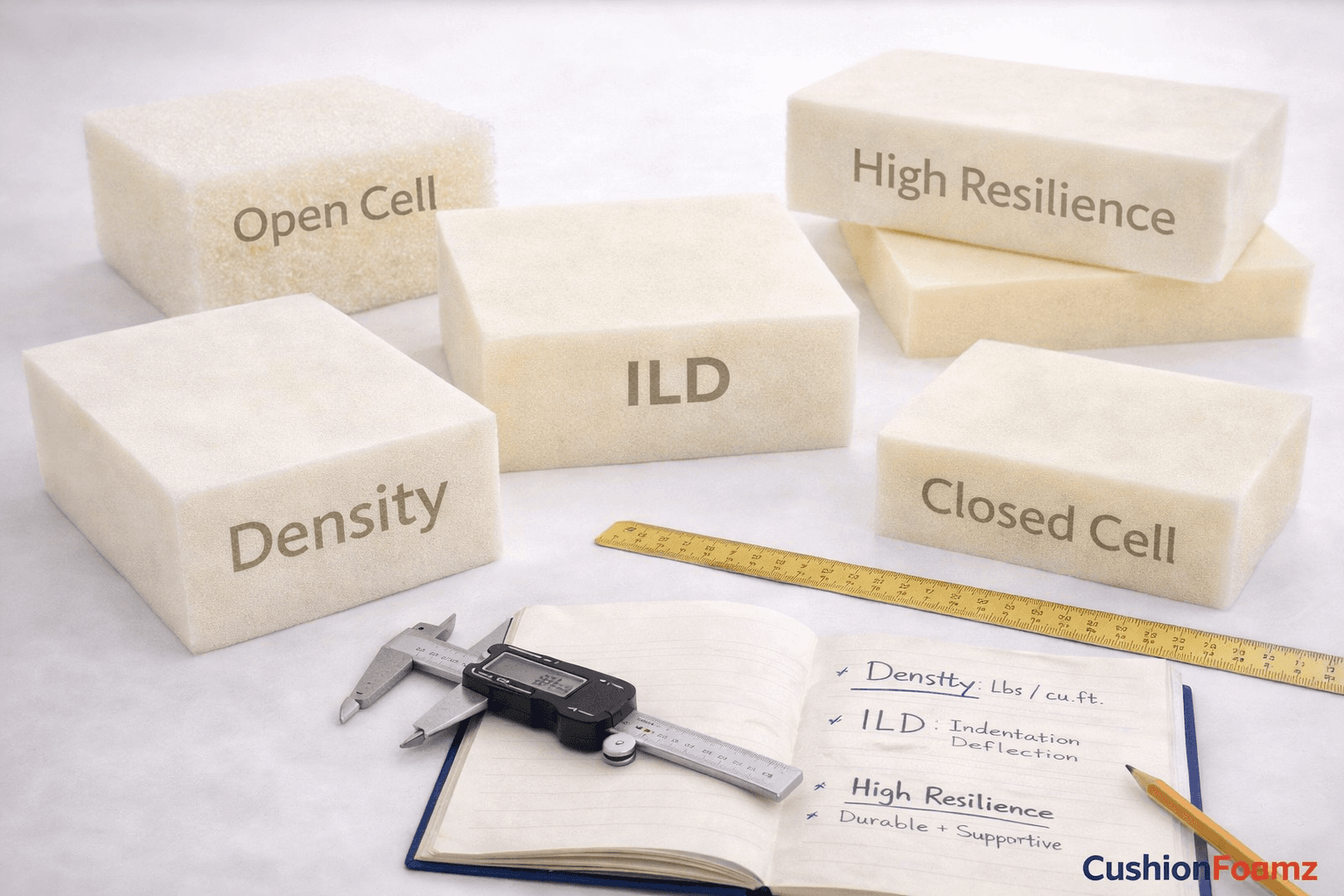
The weight of foam per cubic foot, expressed in lb/ft³ (pounds per cubic foot). Higher density means more material, greater durability, and longer lifespan. Density does not equal firmness — this is the most common foam misconception. Our indoor foam is 2.8 lb/ft³ (professional grade). Full guide: Foam Density and Firmness Explained
Dry Fast Foam
A reticulated polyurethane foam specifically engineered for wet environments. The cell walls are removed during manufacturing, allowing water to drain straight through. Used for outdoor furniture, marine cushions, and poolside seating. Our outdoor foam type. Full guide: Indoor vs. Outdoor Foam
DXA (Double Rub Abrasion)
A measure of fabric durability, not foam. Mentioned here because upholstery fabric abrasion ratings affect how long cushion covers last over foam. See our cushion covers guide for fabric recommendations.
F
Firmness
How soft or hard foam feels when compressed. Measured by ILD (see below). Independent of density — you can have soft high-density foam and firm low-density foam. Our indoor foam comes in medium-firm, which is the professional standard for sofa seating. Full guide: Foam Density and Firmness Explained
Full Wrap
Batting applied to all six surfaces of a foam insert (top, bottom, front, back, and both sides). Provides maximum rounding and softness from every angle. See Dacron batting guide.
H
HD (High Density)
Foam with a density of 1.8 lb/ft³ or higher. In the furniture industry, HD typically refers to conventional hot-cure polyurethane at 1.8 to 2.2 lb/ft³. See our HR vs. HD comparison for how this differs from HR foam.
HR (High Resilience)
A category of polyurethane foam manufactured using a cold-cure process. Characterized by variable cell sizes, fast recovery (high rebound), progressive support, and superior durability. Our indoor foam is HR at 2.8 lb/ft³. Full guide: High Resilience vs. High Density Foam
Hydrolysis
The chemical breakdown of polyurethane caused by prolonged water exposure. Water molecules break the molecular chains in the foam, causing it to crumble and disintegrate. This is why standard foam fails in outdoor and marine environments. Dry Fast foam avoids this by not retaining water.
I
ILD (Indentation Load Deflection)
The standard measurement of foam firmness. A circular plate pushes into a foam sample until it compresses 25 percent, and the force required (in pounds) is the ILD number. Higher ILD = firmer foam. Typical ranges: 8–15 (very soft), 25–35 (medium), 35–45 (medium-firm), 45+ (firm). Full guide: Foam Density and Firmness Explained
L
Lb/ft³ (Pounds Per Cubic Foot)
The unit of measurement for foam density. A one-cubic-foot block of foam is weighed, and the result is its density. Our indoor foam is 2.8 lb/ft³. Budget foam is 1.5 lb/ft³. The difference in durability is dramatic.
M
Memory Foam (Viscoelastic Foam)
A temperature-sensitive polyurethane foam that slowly conforms to body shape and slowly returns to original form. Effective for mattresses but problematic for seating cushions due to slow recovery, heat retention, and bottoming out. Full guide: Memory Foam vs. HR Foam
Medium-Firm
The firmness level of our indoor HR foam, corresponding to approximately ILD 35–45. The professional standard for sofa seat cushions — supportive enough to prevent bottoming out, soft enough for comfortable extended sitting. Works for the widest range of body types.
O
Off-Gassing
The release of volatile organic compounds (VOCs) from new foam. Causes the "new foam smell." In CertiPUR-US certified foam, off-gassing is tested and verified to be within safe limits. Dissipates within 24 to 48 hours. See CertiPUR-US guide.
Open-Cell Foam
Foam where the cell walls allow air (and potentially water) to pass between cells. All seating foam is open-cell to some degree. Dry Fast reticulated foam is maximally open-cell — the cell walls are intentionally removed.
P
Polyurethane (PU)
The base material for the vast majority of furniture foam, including both conventional HD foam and high-resiliency HR foam. A thermosetting polymer created by reacting polyols with isocyanates. Can be formulated in a wide range of densities and firmnesses.
Progressive Support
A characteristic of HR foam where smaller cells compress first for initial softness, then larger cells engage for deeper support. Creates a two-stage feel that is both cushioning and supportive. This is the primary comfort advantage of HR foam over conventional uniform-cell foam.
R
Resilience
A foam's ability to return to its original shape after compression, measured by the ball rebound test (percentage of original height a dropped ball bounces back to). Conventional foam: 40–50%. High-resilience foam: 60%+. Higher resilience = faster recovery and springier feel.
Reticulated Foam
Foam that has undergone a secondary manufacturing process to remove the cell walls, leaving only the cell framework. This creates a foam that is approximately 97% open air and allows water to drain freely through the material. Our Dry Fast outdoor foam is reticulated.
S
Seam-to-Seam Measurement
The proper method for measuring cushion covers for replacement foam. Measure from the inside of one seam to the inside of the opposite seam — not the outside of the cover and not the old foam. Full guide: How to Measure Couch Cushions
Sizing Buffer
The practice of ordering foam slightly larger (typically ½ inch in width and depth) than the cushion cover measures, creating a snug fit that eliminates gaps and wrinkles. Applied when using bare foam without batting. When using Dacron batting, order at exact cover dimensions instead. See ordering mistakes to avoid.
T
T-Shape (T-Cushion)
A cushion shape resembling the letter T when viewed from above. Found on sofas where the seat cushion extends forward over the armrest on one or both sides. Available as a shape option in our configurator. Measuring instructions in our measuring guide.
U
Upholstery Foam
A general term for any foam used in furniture cushioning applications. Encompasses polyurethane foam of all densities, memory foam, latex foam, and specialty foams. At CushionFoamz, our upholstery foam is specifically 2.8 lb/ft³ high-resiliency cold-cure polyurethane.
V
VOCs (Volatile Organic Compounds)
Gases emitted by various materials, including new polyurethane foam. The source of the "new foam smell." CertiPUR-US certification verifies VOC emissions fall within safe limits for indoor air quality. See CertiPUR-US guide.
W
Welting (Piping)
The cord-covered trim that runs along cushion cover seams. Provides visual definition and seam reinforcement. Not a foam term per se, but relevant to cushion construction. See our cushion covers guide.
Still Looking for Something?
This glossary covers the terms you will encounter most frequently when shopping for and working with cushion foam. If you need more depth on any topic, our blog guides provide comprehensive information:
- Foam selection: Density & Firmness Guide | Indoor vs. Outdoor | HR vs. HD Foam
- How to replace foam: Complete Replacement Guide | Measuring Guide | Ordering Mistakes to Avoid
- Specific applications: Boat Cushions | RV Cushions | Patio Furniture | Recliners
- Cost and care: Replacement Cost Guide | Care & Storage | How Long Foam Lasts
Ready to put your knowledge to work? Build your custom cushion →
For personalized help, visit our FAQ page or contact our team — we are happy to help translate any foam question into a clear answer and the right product for your project.