What Is CertiPUR-US Certified Foam? (And Why Your Cushions Should Have It)
When you shop for replacement cushion foam, you will see some sellers prominently display the CertiPUR-US label while others make no mention of certifications at all. If you are replacing foam in a sofa your family sits on for hours every day, this distinction matters more than you might think.
CertiPUR-US is a voluntary certification program that tests polyurethane foam for harmful chemicals and emissions. Foam that carries the CertiPUR-US seal has been independently verified to be made without certain toxic substances and to emit low levels of volatile organic compounds (VOCs). It is the closest thing the foam industry has to a consumer safety standard — and it is the minimum you should accept in any foam that goes into your home furniture.
This guide explains exactly what the certification covers, what it does not cover, and why we made it non-negotiable for every piece of foam we sell at CushionFoamz.
What CertiPUR-US Certification Actually Tests For
CertiPUR-US is administered by a not-for-profit organization that independently tests flexible polyurethane foam. The certification verifies that foam is made without the following substances:
Chemicals Excluded from CertiPUR-US Foam
Ozone depleters — Certain blowing agents used in foam manufacturing (like chlorofluorocarbons) destroy the ozone layer. CertiPUR-US certified foam is made without these chemicals.
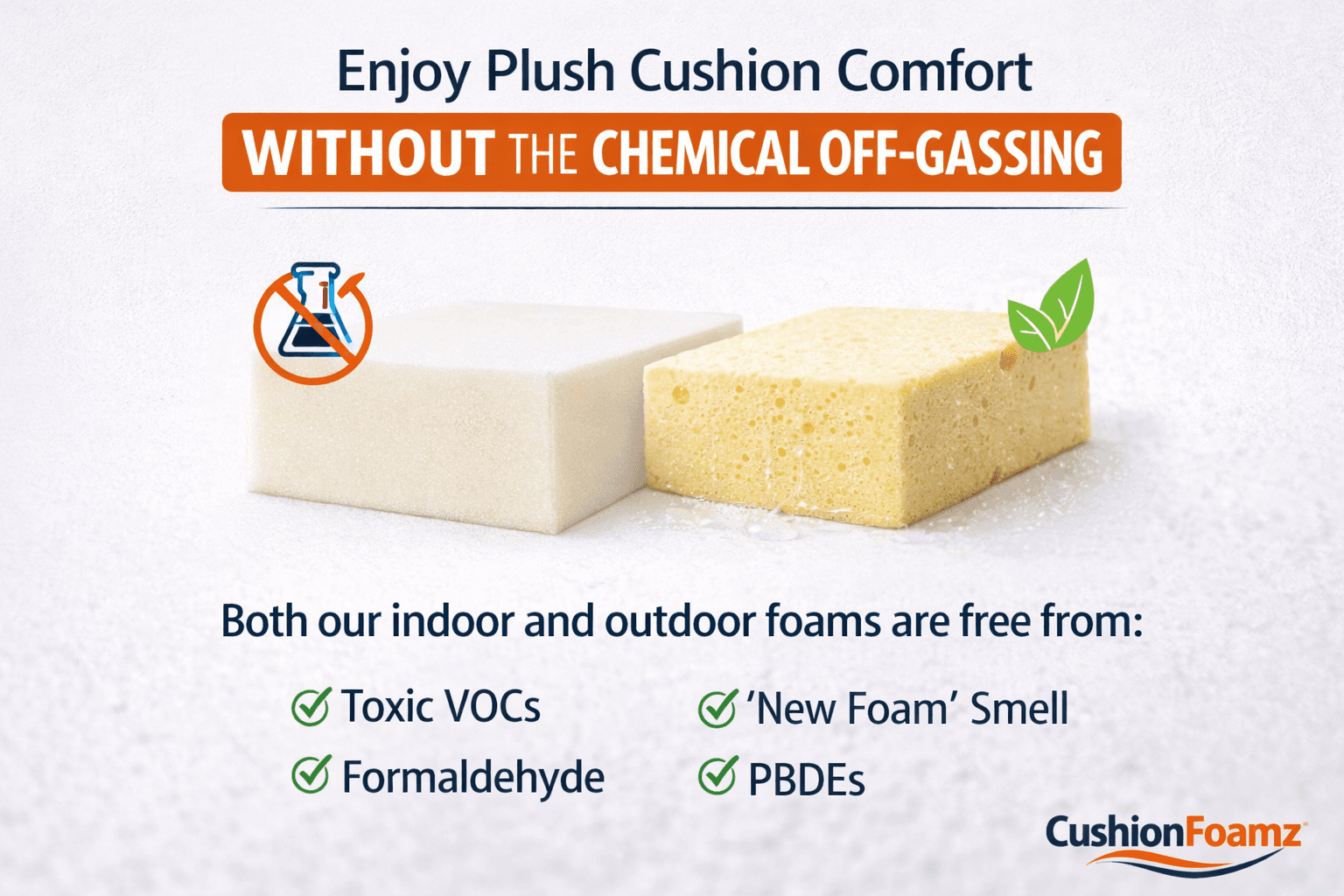
PBDE flame retardants — Polybrominated diphenyl ethers were widely used in foam until research linked them to hormone disruption, neurological damage, and cancer risk. They have been phased out of most manufacturing, but the certification verifies their absence.
TDCPP or TCEP flame retardants — Also known as "Tris," these chlorinated phosphate compounds are classified as probable carcinogens by the state of California. CertiPUR-US foam does not contain them.
Mercury, lead, and other heavy metals — Toxic metals that can accumulate in the body over time. The certification sets maximum allowable limits well below safety thresholds.
Formaldehyde — A known carcinogen that can be present in adhesives and certain foam manufacturing processes. CertiPUR-US foam meets strict formaldehyde emission limits.
Phthalates regulated by the CPSC — Phthalates are plasticizers linked to endocrine disruption. The Consumer Product Safety Commission regulates several specific phthalates in consumer products, and CertiPUR-US foam is verified to be free of these compounds.
Low VOC Emissions
Beyond chemical composition, CertiPUR-US tests for volatile organic compound (VOC) emissions — the gases that foam releases into the air over time. This is what causes the "new furniture smell" and is technically called off-gassing.
All materials emit some level of VOCs, but the concern with foam is prolonged exposure in enclosed spaces. You sit on your sofa for hours. Your face is inches from the cushion surface. In a bedroom, foam mattresses off-gas in a closed room while you sleep for eight hours.
CertiPUR-US certified foam must meet emissions limits for total VOCs, formaldehyde specifically, and other individual compounds. These limits are based on testing standards developed for indoor air quality.
Why CertiPUR-US Matters for Cushion Foam
You Spend Hours on This Material
The average American spends four to five hours per day sitting on their sofa. Children play on it, nap on it, and press their faces into the cushions. Pets curl up on foam surfaces for the majority of the day. The foam inside your furniture is one of the most intimate material exposures in your home — second only to your mattress.
If that foam contains harmful chemicals, you are exposed to them through both skin contact and inhalation for hours every day. CertiPUR-US certification provides a baseline assurance that the chemicals of greatest concern are absent.
Not All Foam Is Created Equal
There is no federal regulation requiring foam manufacturers to test for or disclose the chemicals in their products. Any foam supplier can sell uncertified foam legally, and many do — particularly offshore manufacturers and budget-focused sellers on marketplaces like Amazon.
The foam in your original sofa cushions may or may not be certified. Mass-market furniture manufacturers source from dozens of foam suppliers, and certification status varies. When you replace your foam yourself, you have the opportunity to choose certified foam — an upgrade that costs nothing extra but matters for your household.
The "New Foam Smell" Question
When you unwrap new foam, you will likely notice an odor. This is normal off-gassing and occurs with all polyurethane foam, including CertiPUR-US certified foam. The difference is the composition and volume of what is being released.
Certified foam off-gasses at levels verified to be within safe limits for indoor air quality. The smell typically dissipates within 24 to 48 hours in a well-ventilated space. Uncertified foam may off-gas at higher levels and for longer periods, and may release compounds that are not tested or disclosed.
Our recommendation: unwrap your new foam in a ventilated area and let it air out for a few hours before installing it in cushion covers. By the time you are using it, any residual odor will be negligible. For the full installation process, see our complete couch cushion replacement guide.
What CertiPUR-US Does Not Cover
It is important to understand the certification's boundaries:
It is not an organic or natural certification. CertiPUR-US foam is still polyurethane — a petroleum-based synthetic material. The certification means it is made without certain harmful additives, not that it is made from natural or organic ingredients.
It does not certify firmness, density, or quality. A 1.2 lb/ft³ budget foam and a 2.8 lb/ft³ professional-grade foam can both be CertiPUR-US certified. The certification tells you the foam is safe; it does not tell you it is good. For guidance on quality, see our foam density and firmness guide.
It does not apply to foam covers or adhesives. The certification covers the foam itself. If you use spray adhesive to attach Dacron batting, or if your cushion covers contain chemical treatments, those are separate from the foam certification.
It does not test for all possible chemicals. CertiPUR-US tests for specific categories of substances known to be harmful. There may be other compounds in foam that are not part of the testing protocol. That said, the certification covers the chemicals of greatest established concern.
How to Verify CertiPUR-US Certification
Legitimate CertiPUR-US certification can be verified on the program's official website, where certified foam producers and brands are listed. When a seller claims their foam is certified, you can confirm it by checking the registry.
At CushionFoamz, both of our foam types — indoor high-resiliency foam and outdoor Dry Fast foam — are CertiPUR-US certified. This is stated on our product pages and is verifiable through the certification program.
CertiPUR-US vs. Other Foam Certifications
You may encounter other certifications when comparing foam products:
GREENGUARD Gold — Tests for chemical emissions in indoor environments. More stringent than CertiPUR-US on VOC limits. Primarily found on mattresses and institutional furniture.
OEKO-TEX Standard 100 — A European certification for textiles and textile-adjacent materials. Tests for harmful substances and is widely recognized internationally. Some foam producers carry this certification in addition to or instead of CertiPUR-US.
Global Organic Latex Standard (GOLS) — Applies to natural latex foam, not polyurethane. If you are looking at latex cushion alternatives, GOLS is the relevant certification.
CertiPUR-US is the most widely adopted certification specifically for polyurethane foam in North America. It is the standard that mainstream furniture manufacturers, mattress brands, and foam suppliers reference. If a foam carries the CertiPUR-US label, it meets the baseline safety standard. If it also carries GREENGUARD Gold or OEKO-TEX, even better.
Who Should Care Most About Foam Certification
While foam certification matters for everyone, certain households should be especially attentive:
Families with young children — Children are more sensitive to chemical exposures due to their smaller body size, developing systems, and tendency to put faces and mouths on furniture surfaces.
Pet owners — Pets spend enormous amounts of time on foam surfaces and are also more susceptible to certain chemical exposures. Dogs and cats on sofas are in direct contact with cushion foam for hours daily.
People with chemical sensitivities or allergies — Individuals who react to fragrances, off-gassing, or chemical residues benefit from foam that has been tested for low emissions.
Anyone with respiratory conditions — Asthma and other respiratory issues can be aggravated by VOC exposure. Low-emission certified foam reduces this risk.
Pregnant women — Some of the chemicals excluded by CertiPUR-US (particularly phthalates and certain flame retardants) are of specific concern during pregnancy.
Our Commitment to Certified Foam
At CushionFoamz, CertiPUR-US certification is not optional — it is a requirement for every foam we carry. We chose to limit our product line to two foam types specifically because we wanted to offer only materials we could stand behind completely. Both our indoor HR foam and outdoor Dry Fast foam meet the CertiPUR-US standard.
When you order foam from our configurator, you know exactly what you are getting: professionally graded foam that has been independently tested for safety. No ambiguity, no need to ask, no disclaimers in fine print.
Frequently Asked Questions
Does CertiPUR-US foam cost more than non-certified foam?
Certified foam from reputable suppliers is competitively priced. The certification cost to manufacturers is modest and does not significantly impact retail pricing. At CushionFoamz, our pricing reflects the foam quality (density and resilience), not a certification premium. You get certified foam at the same price you would expect for professional-grade material.
Is CertiPUR-US foam safe for babies and children?
CertiPUR-US foam meets safety standards for chemical content and emissions. For nursery and children's furniture, it provides a verified baseline of safety. If you want the most stringent standard, look for foam that also carries GREENGUARD Gold certification. Our foam's CertiPUR-US certification means it is free from the chemicals of greatest concern for children's health.
Can foam lose its certification over time?
The certification applies to the foam as manufactured. Foam does not develop new harmful chemicals over time — if anything, off-gassing decreases as the foam ages. The certification remains relevant for the life of the product.
Why do some foam sellers not mention CertiPUR-US?
Either their foam is not certified (common with offshore imports and budget sellers), or they do not prioritize communicating it. If a seller does not mention certification status, ask directly. If they cannot confirm, consider it uncertified and weigh that against your priorities.
Does outdoor Dry Fast foam need to be certified too?
Yes. Even though outdoor cushions are used in open-air environments where off-gassing disperses more quickly, the foam still contacts your skin directly. Antimicrobial treatments, manufacturing chemicals, and base material composition all matter regardless of where the cushion is used. Our Dry Fast foam carries the same CertiPUR-US certification as our indoor foam.
The Bottom Line
CertiPUR-US certification is a straightforward, verifiable way to ensure the foam in your furniture meets established safety standards. It is not a luxury or a marketing gimmick — it is a baseline for responsible manufacturing, and it is especially important for materials you are in close contact with for hours every day.
When replacing your cushion foam, choosing CertiPUR-US certified material costs you nothing extra and gives you documented assurance about what is — and is not — in the foam your family sits on.
Ready to order safe, certified foam? Build your custom cushion →
Explore our full product options at our custom sofa cushions page, or see the complete replacement process in our couch cushion foam replacement guide.