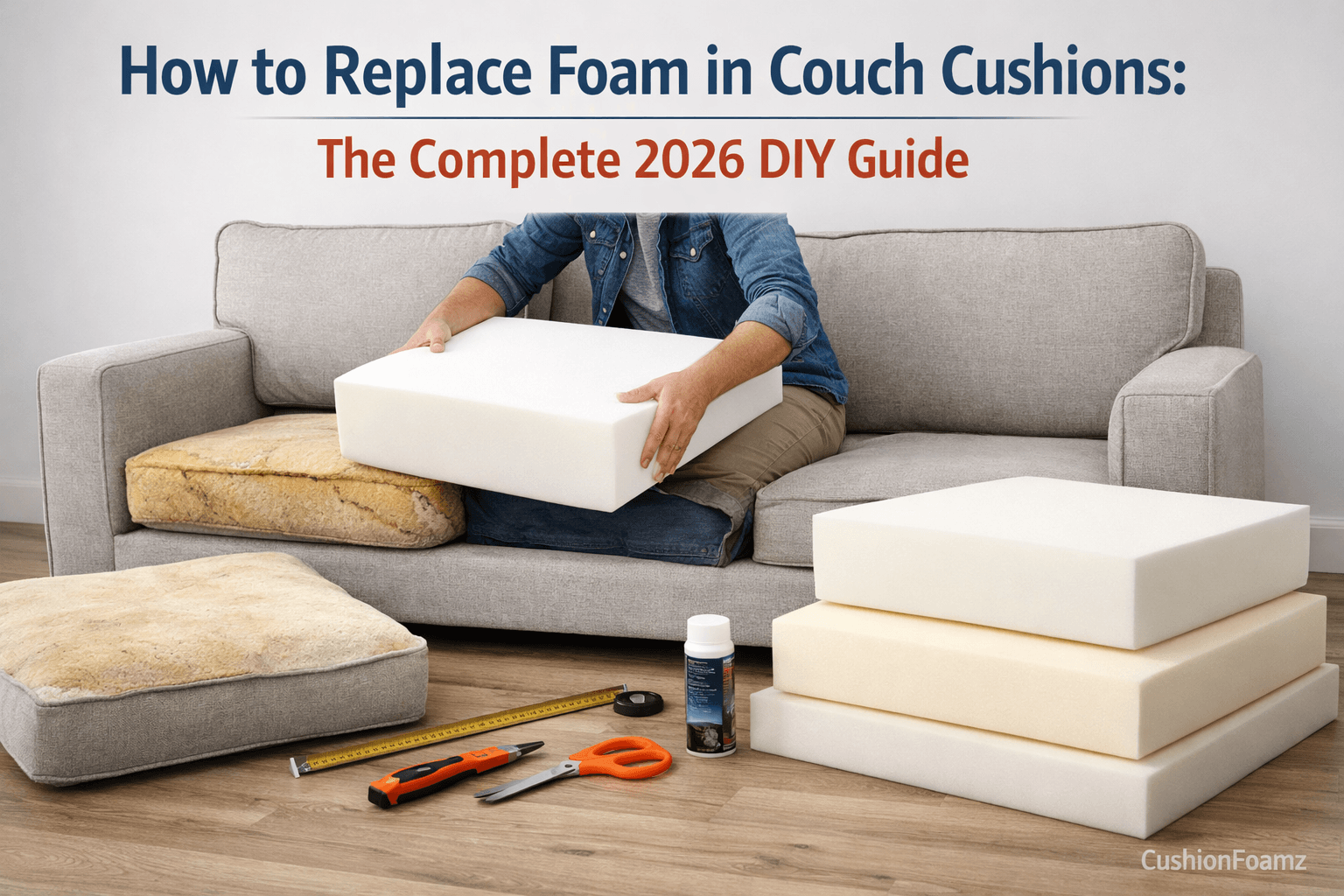
How to Replace Foam in Couch Cushions: The Complete DIY Guide
Flat sofa cushions are one of the fastest ways a living room starts to feel tired — long before the frame or fabric is worn out. In most cases the problem is not the sofa; it is the foam inside the cushions, which has compressed past the point of recovery.
Replacing just the foam is the highest-ROI upgrade in home seating: you keep the sofa you already own, avoid the cost and gamble of buying new, and end up with cushions that often feel better than factory foam because you can choose professional-grade density and firmness.
This guide walks the full path: decide foam type, measure correctly, order precision-cut inserts, and install them cleanly — even if you have never touched upholstery before.
Why Foam Replacement Beats the Alternatives
| Approach | Typical outcome |
|---|---|
| Stuffing batting on top of old foam | Temporary puff; support stays bad |
| Plywood under cushions | Hard seat; does not fix cushion feel |
| Buying a new sofa | Expensive; new sofas often ship with 1.5–1.8 lb foam anyway |
| Replacing foam only | Restores comfort for a fraction of new-furniture cost |
For a deeper cost breakdown, see our sofa cushion foam replacement cost guide.
Step 1: Choose the Right Foam Type
Indoor sofas and chairs (dry environments): Our 2.8 lb/ft³ high-resiliency (HR) indoor foam is the right default for seat and back cushions. It recovers after sitting, resists permanent body impressions better than budget foam, and is CertiPUR-US certified.
Outdoor, marine, or anywhere cushions get wet: Use Dry Fast reticulated foam — standard indoor foam holds water and will mildew. See our indoor vs. outdoor foam guide for the full comparison.
Firmness: For most living-room seating, medium-firm is the sweet spot — enough support for dining posture and getting up, still comfortable for lounging. Heavier sitters or very deep cushions may prefer firm; see best foam for heavy people.
Step 2: Measure Your Cushion Covers (Not the Old Foam)
The old foam is smaller than it was when new. Always measure the empty cover from inside seam to inside seam.
- Add ½ inch to width and depth for a full, professional fit.
- Keep thickness to the cover’s measured thickness (or at most ¼ inch over) so you can still zip the cover.
Full diagrams and edge cases (T-cushions, bullnose, etc.) are in our how to measure couch cushions guide.
Step 3: Order Custom-Cut Foam
- Open our foam configurator.
- Select indoor HR or outdoor Dry Fast based on Step 1.
- Choose the shape that matches your cushion (rectangle, T-shape, circle, etc.).
- Enter the dimensions from Step 2.
- Review price and place your order — most orders ship within a few business days; free shipping over $199.
Avoid common ordering mistakes with 7 mistakes when ordering replacement foam.
Step 4: Install the New Foam
Zippered covers (most sofas):
- Unzip and remove old foam and any loose batting.
- If you use Dacron batting, wrap the new foam before inserting (see Dacron batting guide).
- Plastic bag trick: Put the foam in a thin plastic bag, slide it into the cover, position it, then pull the bag out through the zipper opening. This reduces friction on tight covers.
- Zip closed and plump the cushion by patting corners into place.
No zipper (slip-stitched seam): A local upholsterer can open and re-close the seam for a modest per-cushion fee, or you can DIY with a seam ripper and curved needle if you are comfortable with a simple hand stitch.
Step 5: Care and Longevity
Rotate cushions periodically and avoid leaving heavy objects on cushions for days. Spot-clean indoor foam with mild soap and water; rinse outdoor Dry Fast foam with a hose. More care and storage Q&A is in our cushion foam FAQ.
Frequently Asked Questions
How long does new foam last?
Quality 2.8 lb HR foam often lasts 8–15 years in residential use — far longer than typical big-box replacement foam. See how long cushion foam lasts.
Can I replace foam in a leather sofa?
Yes — same process; leather covers often slide over foam more easily than some fabrics. Tips: leather sofa cushion foam replacement.
Is memory foam good for sofa cushions?
We generally do not recommend memory foam for seating — slow recovery and heat retention work against you on a sofa. Compare in memory foam vs HR foam.
The Bottom Line
Measuring covers, ordering custom-cut HR or Dry Fast foam, and reinstalling with the plastic-bag method is a straightforward weekend project that transforms how your sofa feels — without buying new furniture.
Ready to order? Build your cushion in the configurator →
For density and firmness numbers in plain English, read foam density and firmness explained. For sectionals and modular pieces, see sectional sofa cushion replacement.