Memory Foam vs. HR Foam for Cushions: Why We Don't Recommend Memory Foam
Memory foam has exceptional marketing. The mattress industry has spent billions of dollars associating memory foam with comfort, luxury, and innovation. So when people start thinking about replacing their sofa cushion foam, memory foam is often the first material that comes to mind. If it is great for sleeping, it must be great for sitting, right?
Not quite. Memory foam and seating cushions are a poor match. The very properties that make memory foam effective in a mattress — slow conforming, body-impression retention, temperature sensitivity — become significant drawbacks in a seating application where you sit upright, stand up frequently, share the surface with others, and need the cushion to maintain its shape between uses.
This guide explains exactly why high-resiliency (HR) foam is the superior choice for every cushion application except a few narrow cases, and why we deliberately chose not to carry memory foam despite its popularity.
How Memory Foam Works (And Why That Is a Problem for Seating)
Memory foam is viscoelastic polyurethane — foam that responds to both pressure and temperature. When your body presses into memory foam, the cells compress and slowly conform to your shape. When you remove the pressure, the foam slowly returns to its original form. This slow, conforming behavior is what gives memory foam its signature feel.
In a mattress, this works beautifully. You lie in one position for extended periods. The foam conforms to your body's curves, reducing pressure points at the shoulders and hips. The slow response is not a problem because you are not getting up and sitting down repeatedly.
In a sofa cushion, every one of these characteristics creates a problem.
Problem 1: Slow Recovery
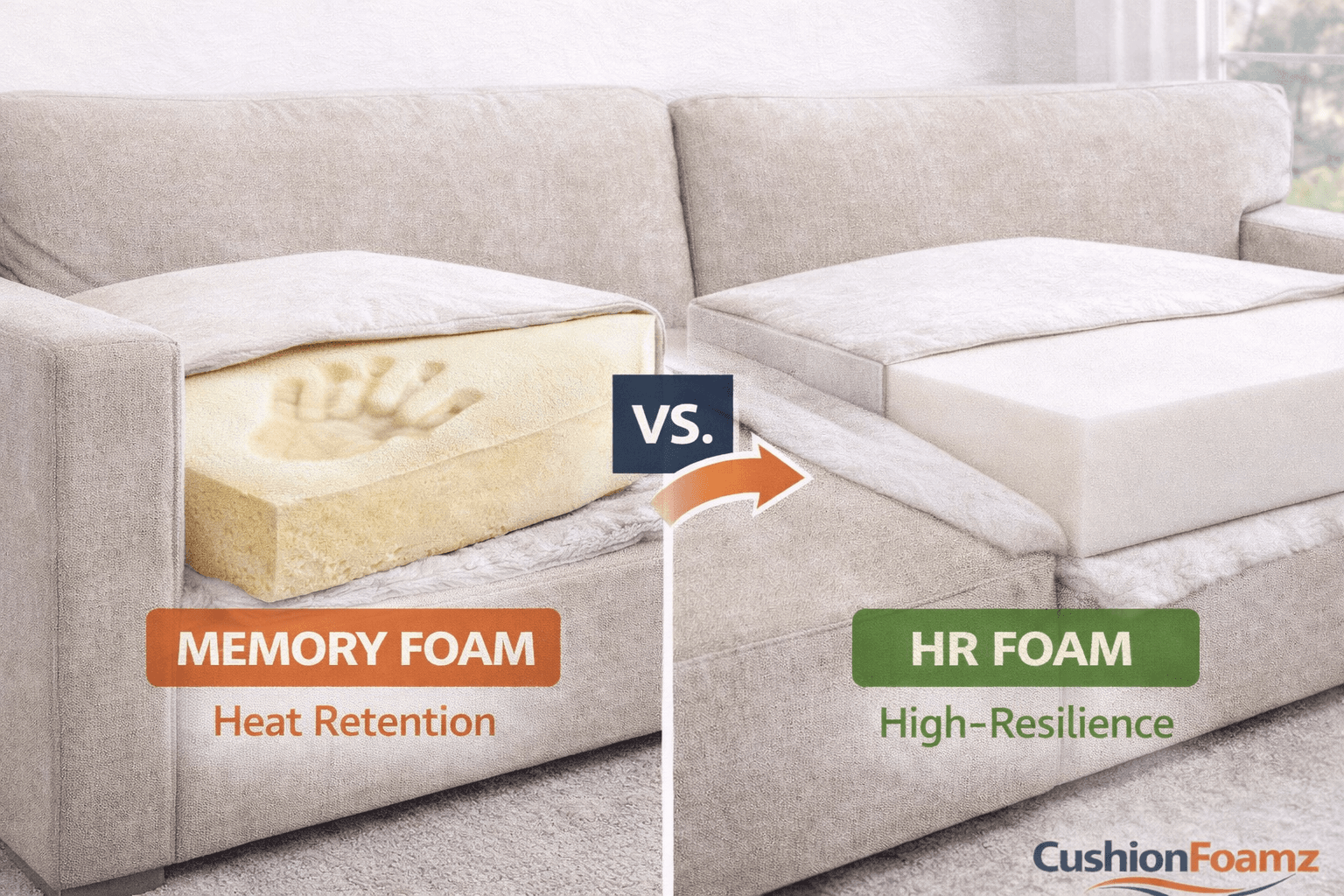
When you stand up from a memory foam cushion, the foam holds your body impression for seconds to minutes before slowly filling back in. On a shared sofa, the next person who sits down finds themselves sitting in the impression of the previous occupant — a depression shaped to someone else's body. The cushion looks perpetually dented and unkempt between uses.
HR foam comparison: High-resiliency foam rebounds in one to two seconds. Stand up, and the cushion is back to its original shape almost instantly. The next person sits on a fresh, even surface. The sofa looks tidy between uses. For more on how resilience is measured and why it matters, see our HR vs. HD foam comparison.
Problem 2: Bottoming Out Under Seated Weight
Memory foam is designed to conform — which means it compresses under load. In a mattress, your weight is distributed across a large surface area (the full length and width of your body). In a sofa seat, your weight is concentrated on a much smaller area (roughly 18 × 20 inches of contact surface). This concentrated load compresses memory foam far more aggressively than lying down does.
At typical cushion thicknesses (four to five inches), memory foam under seated weight compresses to a point where you feel the sofa frame or support webbing beneath. This is called bottoming out, and it eliminates the cushioning benefit entirely. You end up sitting on a thin layer of compressed foam that provides no more support than a folded blanket.
HR foam comparison: High-resiliency foam uses a variable cell structure that provides progressive support — softer cells compress first for initial comfort, then larger cells engage for deep support. This progressive response prevents bottoming out even under heavy loads. Our 2.8 lb HR foam maintains a supportive buffer between your body and the frame at any seated weight up to 350 pounds. See our guide for heavier individuals for specific weight recommendations.
Problem 3: Heat Retention
Memory foam's conforming behavior is driven by temperature sensitivity. Body heat softens the foam, allowing it to mold around you. This means the foam traps and retains body heat at the contact surface. In a mattress, this is a known complaint — hence the rise of "cooling gel" memory foam variations designed to mitigate the problem.
In a sofa cushion, heat buildup is even more noticeable because seated posture concentrates body contact into a smaller area with less airflow. After thirty to sixty minutes of sitting, a memory foam cushion becomes uncomfortably warm. In summer or in homes without air conditioning, this effect is amplified significantly.
HR foam comparison: HR foam is temperature-neutral. Its firmness and support properties remain consistent regardless of ambient temperature or body heat. You get the same feel in a cold room as a warm one, and the foam does not trap heat at the seating surface.
Problem 4: Temperature-Dependent Firmness
Because memory foam is viscoelastic, its firmness changes with temperature. In a cold room (or a cold van, RV, or cabin), memory foam becomes noticeably firmer — sometimes uncomfortably so. In a warm environment, it becomes softer and less supportive. This means the feel of your cushion varies depending on the season, the time of day, and whether the heating or cooling system is running.
HR foam comparison: HR foam maintains consistent firmness across the full range of indoor temperatures. The cold-cure manufacturing process creates cells that respond to mechanical pressure (your weight) rather than thermal conditions. Whether your living room is 60°F or 85°F, the cushion feels the same. This is especially important for RV and van life applications where interior temperatures can swing dramatically.
Problem 5: Inadequate Support for Upright Seating
Mattresses support you in a horizontal position where gravity distributes your weight evenly across the surface. Sofa cushions support you in a seated position where your weight is concentrated at the sit bones and your spine requires active support from below. These are fundamentally different ergonomic demands.
Memory foam's conforming nature allows your body to sink into the material, which in seated posture means your hips drop below your knees. This tilted-pelvis position rounds your lower back, creates hip flexor tension, and produces the very discomfort you were trying to eliminate. Over extended sitting, the foam conforms increasingly deeply, worsening the postural problem.
HR foam comparison: Medium-firm HR foam provides enough give for initial comfort but maintains a firm base that keeps your hips at or above knee level — the seated posture that supports spinal alignment. The foam does not progressively sink under sustained load.
Problem 6: Shorter Effective Lifespan in Seating
Memory foam degrades under the repeated compression cycles of daily seating use. The viscoelastic cells lose their ability to fully recover over time, developing permanent body impressions. In a mattress where you rotate and flip periodically, this can be managed. In a sofa cushion where you sit in the same spot daily, permanent impressions develop faster.
HR foam comparison: The 2.8 lb HR foam we carry at CushionFoamz is designed for exactly this type of repeated daily compression. Its cold-cure cell structure resists permanent deformation for eight to fifteen years under daily residential use. For the complete lifespan analysis, see our guide on how long cushion foam lasts.
When Memory Foam Does Work
Memory foam is not a bad material — it is a bad choice for seating cushions specifically. There are legitimate applications:
As a thin comfort layer on top of HR foam. A one-inch memory foam topper on a four-inch HR foam base creates a two-stage cushion: the memory foam provides surface conforming while the HR foam provides structural support. This hybrid approach can work for cushions that are primarily sleeping surfaces (a guest room daybed, a van life sleeping platform). For more on this approach, see our discussion of toppers vs. full replacement.
In dedicated mattresses. Memory foam's properties are well-suited to sleeping applications, especially when combined with a supportive base layer and proper bed frame ventilation.
In automotive seating. Car seats use memory foam in thin layers as part of a multi-material seat construction designed by automotive engineers. This is a specialized application with materials and construction far different from a DIY cushion project.
The Cost Comparison
Memory foam typically costs more per cubic inch than HR foam of equivalent quality. The higher cost does not translate to better seating performance — it is a premium you pay for the brand recognition and mattress-industry marketing that has elevated memory foam's reputation.
Our 2.8 lb HR foam at $0.07 per cubic inch provides professional-grade seating performance at a competitive price. Calculate your exact project cost in our foam configurator.
What About "Cooling Gel" Memory Foam?
Gel-infused memory foam addresses the heat retention problem but not the other five issues. The foam still conforms slowly, still bottoms out under seated weight, still develops body impressions, and still varies with temperature. Gel infusion reduces surface heat accumulation but does not change the fundamental material behavior that makes memory foam unsuitable for seating.
Frequently Asked Questions
Can I use memory foam for sofa back cushions?
Back cushions bear much less weight than seat cushions, making some of memory foam's weaknesses less pronounced. However, the slow recovery and temperature sensitivity still apply. HR foam in a slightly softer configuration provides better back support without the drawbacks. If you insist on memory foam for back cushions, use it as a thin layer over an HR foam core — never as the sole cushion material.
I already bought memory foam cushions and they are not comfortable. What should I do?
Replace them with HR foam. If the cushion covers are in good condition, simply remove the memory foam and insert custom-cut 2.8 lb HR foam in the same dimensions. The improvement will be immediate and dramatic — proper support, instant recovery, and temperature-neutral comfort. Follow our couch cushion replacement guide for the step-by-step process.
Why do some foam companies sell memory foam for cushions?
Because customers ask for it. Memory foam has strong brand recognition from the mattress industry, and some sellers prioritize meeting customer requests over providing the best recommendation. We chose not to carry memory foam because we believe in selling only materials we can genuinely stand behind for their intended application. For cushions, that material is HR foam.
Is memory foam at least more durable than cheap polyurethane?
In seating applications, not meaningfully. Budget polyurethane (1.5 lb/ft³) fails through mechanical fatigue in one to three years. Memory foam in seating fails through a combination of permanent impression formation and loss of viscoelastic response in two to five years. Neither comes close to 2.8 lb HR foam's eight to fifteen year lifespan. For the full breakdown of how foam density affects durability, see our density guide.
The Bottom Line
Memory foam is excellent mattress material that has been successfully marketed into applications where it does not belong. For sofa cushions, chair seats, bench seating, and every other seating application, high-resiliency foam outperforms memory foam in recovery speed, support consistency, heat neutrality, durability, and cost-effectiveness.
If you want cushions that feel supportive on day one and still feel supportive on year ten — without heat buildup, body impressions, or temperature-dependent firmness — HR foam is the clear choice.
Ready to choose the right foam? Build your custom HR foam cushion →
Explore our upholstery foam specifications for complete product details, or visit our FAQ page for more answers about foam selection.