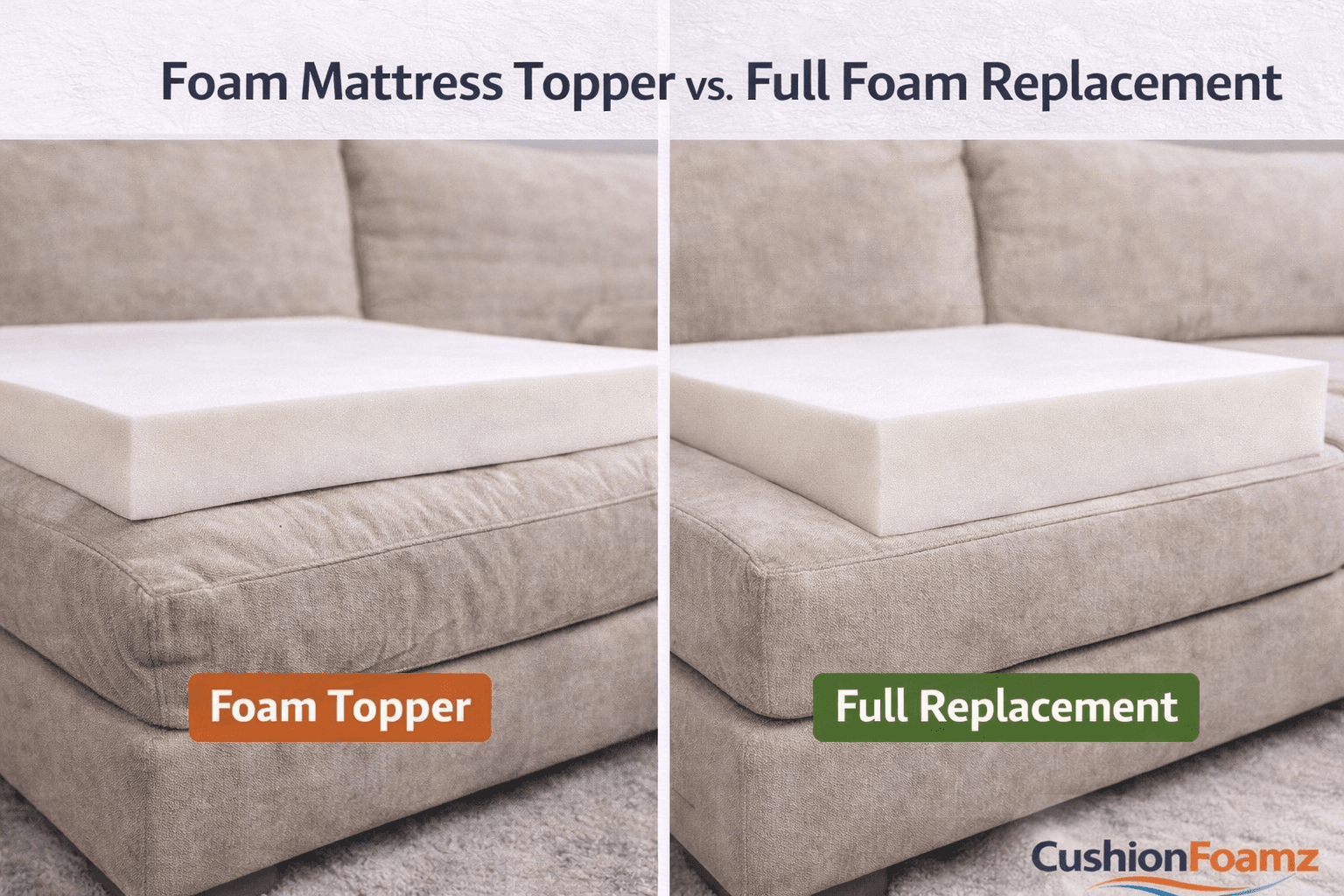
Foam Mattress Topper vs. Full Foam Replacement: Which Do You Need?
Your cushions are uncomfortable. You are looking for the quickest, cheapest fix. A foam topper seems appealing — just lay it on top of the existing cushion and you are done, right? No measuring, no removing covers, no waiting for custom foam.
That logic is why foam toppers sell so well. And it is also why most topper purchases end in disappointment within a few weeks. Toppers have a very narrow window of situations where they actually solve the problem. For the vast majority of sagging cushion issues, full foam replacement is the only approach that delivers lasting results.
This guide gives you the honest comparison — when toppers work, when they do not, and how to determine which approach your specific situation requires.
How Foam Toppers Work
A foam topper is a thin slab of foam (typically one to three inches thick) placed on top of an existing cushion or mattress to modify the surface feel. The topper adds a new comfort layer without replacing the underlying material.
In theory, the topper provides softness and pressure relief while the existing foam beneath provides structural support. The two layers work together — fresh comfort on top, firm foundation below.
In practice, this only works when the existing foam is still structurally sound. If the foundation has failed, adding a comfort layer on top is like putting a pillow on a concrete floor. The surface feels softer for a moment, but you quickly sink through the thin topper and feel the hard, unsupportive base beneath.
When a Topper Actually Works (The 15% of Cases)
A foam topper is an appropriate solution in a limited set of circumstances:
The Existing Foam Is Too Firm — Not Degraded
If your cushion foam still springs back when pressed, still maintains its shape, and still supports your weight without bottoming out — but simply feels too firm for your preference — a soft topper can modify the feel without replacing functional foam. This is common with brand-new furniture that feels harder than expected.
You Want to Change the Feel of a Functional Mattress
A two-inch soft foam or memory foam topper on a firm but functional mattress can create a softer sleeping surface without the cost of a full mattress replacement. The firm mattress provides the structural base while the topper provides surface conforming.
A Specific Comfort Layer Is Missing
Some cushion constructions are designed as multi-layer systems — a firm foam base with a softer comfort layer on top. If the comfort layer has degraded but the base layer is still firm, replacing just the comfort layer (effectively a topper) is the right fix.
Temporary Fix Until You Can Do a Full Replacement
If budget or timing prevents immediate foam replacement, a topper buys you a few weeks of improved comfort while you plan the real fix. This is a band-aid, not a solution, but it serves a purpose.
When a Topper Does NOT Work (The 85% of Cases)
The Existing Foam Is Compressed or Bottoming Out
This is the most common scenario — and the one where toppers fail completely. If your existing foam has lost its height, density, and resilience, it cannot serve as a structural base for a topper. Your weight will compress through the topper into the dead foam below, and you will feel the frame within minutes.
Test: Remove the cushion cover and press your fist firmly into the existing foam. If the foam compresses to within an inch of the bottom and does not spring back immediately, it is structurally dead. A topper cannot compensate for a failed foundation.
The Cushion Has Visible Body Impressions
Permanent body impressions mean the foam has undergone irreversible cellular collapse in specific areas. A topper laid over impressioned foam will conform to the same uneven surface beneath it, creating a lumpy, asymmetric feel. The impressions need to be eliminated (by replacing the foam), not covered up.
The Existing Foam Is More Than 5 Years Old Under Daily Use
Foam that has been compressed daily for five or more years has lost a significant percentage of its original properties, even if it does not show dramatic visible deterioration. The cellular structure is weakened throughout, not just at the surface. A topper addresses only the surface, leaving the compromised core underneath. See our guide on how long cushion foam lasts for the complete lifespan timeline.
You Can Feel the Frame Through the Cushion
If you can feel springs, webbing, or the wooden frame through your existing cushion, no reasonable thickness of topper will create enough buffer. The existing foam has lost too much height and density. Full replacement with adequate thickness (four to six inches of 2.8 lb HR foam) is the only approach that restores proper separation between your body and the hard surfaces below.
The Topper Slides or Bunches
Toppers sit on top of cushion covers, not inside them. Without being enclosed in a cover, they slide around during use, bunch up when you shift position, and generally behave like an unsecured foam pad on a slippery surface. This is a persistent annoyance that full replacement eliminates entirely — properly fitted foam inside a zippered cover does not move.
The Cost Comparison
The cost difference between a topper and full replacement is smaller than most people expect:
| Approach | Typical Cost (3-Seat Sofa) | Effective Lifespan | 5-Year Cost |
|---|---|---|---|
| Foam topper (2 in, pre-cut) | $30–$80 | 6–18 months | $100–$400 |
| Full foam replacement (custom-cut 2.8 lb HR) | $80–$210 | 8–15 years | $80–$210 |
| Topper + eventual replacement | $110–$290 | N/A | $180–$610 |
The topper route often leads to eventual full replacement anyway — you have spent money on a temporary fix that did not solve the problem, then spent money on the real fix. Starting with full replacement saves the topper cost entirely.
For detailed pricing on full foam replacement, see our sofa cushion foam replacement cost guide.
The Decision Framework
Ask yourself these three questions:
Question 1: Does my existing foam still bounce back when I press on it?
- Yes: A topper might work (if the issue is firmness preference, not degradation).
- No: Full replacement needed. The foundation is gone.
Question 2: Can I feel the sofa frame through the cushion when sitting?
- Yes: Full replacement needed. No topper is thick enough to compensate.
- No: Either approach may work — proceed to question 3.
Question 3: Has this foam been used daily for more than 4 years?
- Yes: Full replacement recommended. Even if the foam seems okay, its best years are behind it and a topper only delays the inevitable.
- No: If the foam still passes tests 1 and 2, a topper can modify the feel.
If you answered "No" to question 1 or "Yes" to question 2, skip the topper and replace the foam. You will save money in the long run and get a dramatically better result.
How to Do a Full Replacement
Full foam replacement is simpler than most people expect:
- Measure your cushion covers from seam to seam. Follow our measuring guide.
- Choose your foam — indoor HR foam for furniture or outdoor Dry Fast foam for exposed areas.
- Order through our configurator — enter dimensions, see price instantly.
- Install — unzip cover, remove old foam, insert new foam, zip closed.
The entire process takes fifteen minutes per cushion. For the complete walkthrough, see our couch cushion replacement guide. For a visual of what the results look like, see our before and after transformations.
What About Memory Foam Toppers?
Memory foam toppers are heavily marketed for both mattresses and furniture cushions. For mattresses, they can work as a comfort modifier on a firm but functional base. For sofa cushions, they add the problems of heat retention, slow recovery, and temperature sensitivity on top of the topper's inherent drawbacks (sliding, bunching, failure to address a dead foundation).
If you are considering a memory foam topper for your sofa, read our detailed memory foam vs. HR foam comparison before purchasing. In almost every case, full replacement with HR foam is the better investment.
Frequently Asked Questions
Can I put a topper inside my cushion cover on top of the existing foam?
You can, but it creates a new problem: the combined thickness (old foam + topper) may be too thick for the cover. If the cover zips closed, this approach can work as a temporary improvement. If the cover cannot close or the cushion looks overstuffed, the dimensions are wrong and full replacement at the correct single thickness is needed.
I just bought new furniture and the foam is already too soft. Topper or replacement?
For brand-new furniture where the foam is soft but not degraded, a firm topper can add support without replacing functional material. However, if the foam is truly low-quality (1.5 lb/ft³ or lower), it will degrade quickly regardless. Replacing it with 2.8 lb HR foam now prevents having to do it again in two years when the factory foam fails. For perspective on what foam your specific furniture brand likely used, see our guide to popular sofa brands.
Are there situations where both a topper AND new foam make sense?
Yes — in sleeping applications. A 4-inch firm HR foam base with a 1 to 2 inch soft topper creates a two-layer system: structural support from the base, plush comfort from the topper. This is the approach many premium mattresses use. For seating cushions, a single piece of medium-firm HR foam at the correct thickness provides both support and comfort without the complexity of layers.
What if I want to try a topper first and replace later if it does not work?
That is a reasonable approach if budget is extremely tight. Buy an inexpensive foam topper, use it for a few weeks, and evaluate honestly. If it solves the problem, great. If you still feel the frame, still have body impressions, or find the topper sliding around constantly, you have your answer: full replacement is needed. Just be honest with yourself about the results rather than rationalizing a mediocre fix.
The Bottom Line
Foam toppers are a narrow solution for a narrow problem: modifying the surface feel of structurally sound foam. For the vast majority of sagging, compressed, and uncomfortable cushion situations, full foam replacement is the only approach that actually solves the problem.
The cost difference is modest. The effort difference is minimal. The result difference is enormous. Replace the foam, do it right, and do it once.
Ready to replace instead of patch? Build your custom cushion →
Start with our complete replacement guide or check our FAQ page for answers to common questions.