How to Measure Couch Cushions for Replacement Foam (So They Fit Perfectly)
You have decided to replace the foam in your couch cushions — great decision. Now comes the step that makes people second-guess themselves: measuring. What if the foam arrives and it does not fit? What if it is too big for the cover, or too small and leaves gaps that make the cushion look deflated?
Here is the reassurance you need: measuring cushion covers is genuinely simple. It requires a tape measure, five minutes per cushion, and one critical rule that eliminates almost every sizing mistake people make. This guide will walk you through every cushion shape you might encounter, show you the common errors that lead to bad fits, and give you the confidence to enter your dimensions into our custom foam configurator knowing the result will be perfect.
If you have not yet decided on the right foam type or density for your project, start with our complete couch cushion replacement guide for the full process from start to finish.
The Number One Rule: Measure the Cover, Not the Old Foam
This is the single most important thing to remember, and it is the mistake responsible for the majority of ill-fitting foam orders across the entire industry.
Never measure your old foam insert. By the time you are replacing it, the old foam has compressed, sagged, warped, and potentially lost inches of its original dimensions. A cushion that started as a 24 × 24 × 5 inch insert might measure 22 × 23 × 3.5 inches after years of use. If you order foam based on those degraded dimensions, it will be undersized — and your cushion will look baggy and sad instead of full and plump.
Instead, measure the cushion cover itself from seam to seam. The cover retains its original dimensions because fabric does not compress the way foam does. The cover is the blueprint. The foam needs to match it.
Tools You Need
- Flexible tape measure — A fabric or retractable metal tape measure. Do not use a rigid ruler or yardstick, as they cannot conform to curves.
- Notepad or phone — Write down every measurement immediately. Do not trust your memory, especially when measuring multiple cushions.
- A flat surface — Lay the empty cover flat on a table or the floor to get the most accurate measurements.
That is all. No specialized tools required.
How to Measure Rectangular Cushions
Rectangular cushions are the most common sofa cushion shape. Here is the process:
Step 1: Remove the Cover
Unzip the cushion cover and pull out the old foam. If there is Dacron batting wrapped around the foam, note that — you may want to add batting to your new foam order as well.
Step 2: Lay the Cover Flat
Spread the empty cover on a flat surface with the zipper side down (the zipper side is typically the bottom or back of the cushion). Smooth out any wrinkles and let the fabric settle naturally — do not stretch or pull it taut.
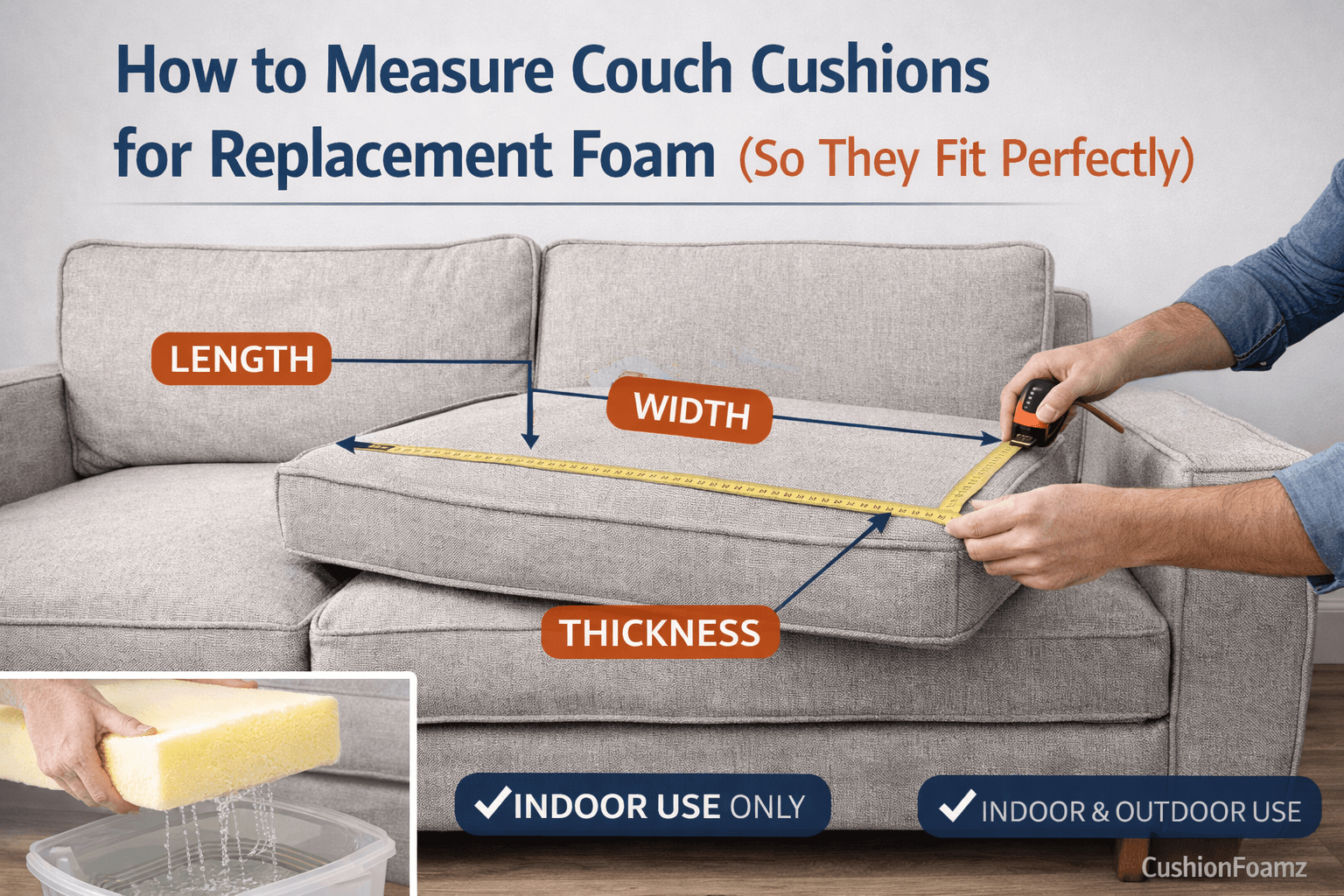
Step 3: Measure Width
Measure from the left inside seam to the right inside seam. This is the dimension that runs parallel to the front edge of the sofa (left to right as you face the couch). Record this number.
Step 4: Measure Depth
Measure from the front inside seam to the back inside seam. This is the dimension that runs perpendicular to the sofa back (front to back as you sit). Record this number.
Step 5: Measure Thickness
This is where people most often go wrong. Measure from the top inside seam to the bottom inside seam. Pinch the top and bottom fabric layers together at one corner to find the seam lines, then measure the distance between them.
Do not estimate thickness by looking at the cover from the side — the fabric drapes and distorts the visual appearance. Measure it directly.
Step 6: Add the Sizing Buffer
For a snug, professional-looking fit, add a half inch to your width and depth measurements. This ensures the foam completely fills the cover without gaps or bagginess. The foam compresses slightly when inserted, which is what creates that full, plump appearance.
Do not add extra to the thickness. Order the exact thickness the cover measures, or at most a quarter inch over. Overstuffing the thickness makes the cushion difficult to zip closed and creates an unnatural dome shape.
| Measurement | How to Measure | Sizing Buffer |
|---|---|---|
| Width (left to right) | Inside left seam to inside right seam | Add ½ inch |
| Depth (front to back) | Inside front seam to inside back seam | Add ½ inch |
| Thickness (top to bottom) | Inside top seam to inside bottom seam | Exact or +¼ inch max |
How to Measure T-Shaped Cushions
T-shaped cushions are found on sofas where the seat cushion extends forward over the armrest on one or both sides, creating a shape that looks like the letter T when viewed from above. These are extremely common on traditional and transitional sofas.
Understanding T-Shape Dimensions
A T-shape cushion has two sets of width and depth measurements:
- The main body — the wide portion that spans the full width of the seating area including the wings over the armrests.
- The front extension — the narrower portion that sits between the arms (or between one arm and the neighboring cushion).
Measuring Process
- Lay the cover flat with the T-shape visible from above.
- Total width: Measure the widest point of the T from left edge to right edge (including the wings).
- Front width: Measure the narrower front portion between the wings.
- Total depth: Measure from the very front seam to the very back seam.
- Wing depth: Measure from the back seam to where the wing ends (where the cushion narrows from the full width to the front width).
- Thickness: Same as rectangular — top seam to bottom seam.
When you use our configurator, select the T-shape option and you will see a diagram showing exactly where each dimension goes. Enter your numbers and the system handles the rest.
How to Measure L-Shaped Cushions
L-shaped cushions typically appear on sectional sofas at the corner junction. The measurement approach is similar to T-shapes but with the extension on a different axis.
- Lay the cover flat so the L-shape is visible.
- Measure the total length of the longer side of the L.
- Measure the total width of the wider side of the L.
- Measure the shorter leg length — the distance from the inner corner to the end of the shorter side.
- Measure the shorter leg width — the dimension of the narrower portion.
- Measure thickness as always.
L-shapes require more measurements, but the principle is the same: seam to seam, add a half inch to the length and width dimensions, and keep thickness exact.
How to Measure Bullnose (Rounded Front) Cushions
Bullnose cushions have a rounded front edge instead of a squared-off corner. They are common on mid-century modern sofas and many contemporary designs.
The good news is that bullnose cushions measure the same way as rectangles — you just need to indicate the bullnose shape when ordering:
- Measure width, depth, and thickness exactly as you would for a rectangular cushion.
- Note the radius of the curve — is it a gentle curve (large radius) or a tight curve (small radius)?
- In our configurator, select the bullnose shape option and enter your dimensions. We cut the rounded front edge precisely to match.
How to Measure Round or Circular Cushions
For round cushions (common on bar stools, papasan chairs, and some accent pieces):
- Measure the diameter — the widest point from one inside seam straight across to the opposite inside seam.
- Measure thickness as usual.
- Select the circle shape in our foam configurator and enter the diameter and thickness.
For ovals, measure both the length (longer axis) and width (shorter axis).
Measuring Tips for Specific Furniture Types
Sofas with Attached (Non-Removable) Cushions
Some sofas have cushions sewn directly to the frame with no zipper access. In this case:
- Measure the visible seating surface dimensions from seam to seam.
- Measure the thickness by pressing down on one side and measuring the depth of the cushion from the sitting surface to the frame/decking below.
- A local upholsterer can open the upholstery, insert new foam, and re-sew it for typically $20–$40 per cushion. See our FAQ for more guidance on this scenario.
RV and Camper Cushions
RV cushions often have unusual shapes — trapezoids, pentagons, or irregular curves that follow the vehicle's interior contours. The best approach is to make a paper template: lay butcher paper or newspaper over the cushion area, trace the outline, and measure the template. Our RV cushion guide covers this process in detail for every common RV layout.
Boat Cushions
Marine cushions present similar challenges to RV cushions — irregular shapes dictated by the hull and deck layout. Paper templates are the most reliable method for complex boat cushion shapes. For straight-forward bench seats and helm chairs, standard measurements work fine. See our boat cushion foam guide for marine-specific measuring tips.
Window Seats and Built-In Benches
For built-in seating where there is no existing cushion cover to measure, measure the seating surface itself — the platform where the cushion will sit. Measure length, width (or depth), and decide on your desired thickness (three to five inches is typical for window seats). For non-rectangular window seats like bay windows with angled segments, our window seat cushion guide walks through the measuring process for every configuration.
Common Measuring Mistakes (And How to Avoid Them)
Mistake 1: Measuring the Old Foam
We have said it already but it bears repeating. Measure the cover, not the foam. Compressed foam gives you undersized measurements every time.
Mistake 2: Measuring the Outside of the Cover
Measure from inside seam to inside seam. The outside of the cover includes seam allowances that add a quarter to half inch per side. Measuring the outside will give you foam that is too large to fit in the cover.
Mistake 3: Rounding Down
If a measurement falls between numbers — say 23 and three-quarters inches — round up to 24 inches, not down to 23.5 inches. Slightly oversized foam compresses into the cover for a full look. Slightly undersized foam leaves gaps.
Mistake 4: Forgetting to Account for Batting
If you plan to wrap your new foam in Dacron batting, keep your foam dimensions the same as the cover measurements (without the half-inch buffer). The batting adds approximately a quarter to half inch on each side, effectively serving as the buffer. If you add the buffer AND wrap in batting, the cushion may be too tight to zip closed.
Mistake 5: Measuring Only One Cushion
If you are replacing multiple cushions, measure each one separately. Cushion covers on the same sofa are not always identical — especially on older furniture where covers may have stretched differently, or on sectionals where end pieces differ from middle pieces.
What If My Cushion Is a Weird Shape?
Our configurator handles rectangles, T-shapes, L-shapes, circles, and bullnose shapes. For truly unusual shapes — irregular curves, trapezoids, notched corners, or anything else — you have two options:
- Make a paper template. Trace the shape on butcher paper, cardboard, or newspaper. Note the thickness. Contact us with the template and we will cut to match.
- Send us a photo and dimensions. Take a photo of the cushion cover laid flat with a tape measure visible for scale. Email it to us with your measurements and we will confirm the best approach.
We cut foam with quarter-inch precision, so even complex shapes come out fitting perfectly.
Ready to Order?
You have your measurements. You know which foam type you need — indoor HR foam or outdoor Dry Fast foam. And you know what density and firmness suits your application from our foam density guide.
Now it is time to turn those numbers into new cushions.
Open the CushionFoamz configurator → Enter your shape, dimensions, and foam type. See your price instantly. Most orders ship within two to five business days with free shipping over $199.
Have questions about your specific measurements? Visit our How It Works page for the full process overview, or reach out through our contact page — we are happy to double-check your dimensions before you place your order.