Boat Cushion Foam Replacement: Why Dry Fast Foam Is the Only Smart Choice
If you own a boat, you have a relationship with waterlogged cushions. You know the drill — you lift a seat cushion after a rain or a rough crossing and it weighs three times what it should. You squeeze it and a stream of murky water runs out. You set it in the sun to dry, but two days later it still smells like a wet basement. Eventually, dark mold spots appear. And at some point, you either toss the cushions overboard in frustration or resign yourself to sitting on damp, mildewy foam every time you go out.
This is not a maintenance failure. It is a materials failure. The foam inside your boat cushions is almost certainly standard closed-cell or semi-open polyurethane — the same type used in living room sofas. That foam was never designed to get wet. The fact that a boat manufacturer put it on a vessel that lives in water is one of the most baffling cost-cutting decisions in the marine industry.
The solution is simple and permanent: replace your boat cushion foam with Dry Fast reticulated foam — the only foam type specifically engineered for constant moisture exposure. This guide covers everything you need to know about the swap.
Why Standard Foam Fails on Boats
To understand why Dry Fast foam is necessary, you need to understand why regular foam fails so catastrophically in marine environments.
Standard polyurethane foam has a closed-cell or semi-open-cell structure. When water hits the surface, it gets trapped in the cells. The foam acts like a sponge — it absorbs water and holds it. In a marine environment, the foam is constantly exposed to spray, rain, condensation, splashes, and humidity. It never fully dries because the next moisture event happens before the last one evaporates.
The consequences cascade:
Weight gain. A saturated foam cushion can weigh five to ten times its dry weight. On a small boat, this adds meaningful ballast you did not plan for.
Mold and mildew. Trapped moisture in a dark, enclosed space (under a cushion cover, inside a storage compartment) is a perfect incubator for mold. Once mold colonizes the foam's internal cell structure, it cannot be removed. The cushion must be discarded.
Structural breakdown. Repeated wet-dry cycles cause polyurethane to hydrolyze — a chemical process where water breaks the molecular chains in the foam. The foam literally disintegrates over time, becoming crumbly and losing all support.
Odor. Mold, mildew, and stagnant water trapped in foam produce a persistent musty smell that permeates the entire cabin. Every boat owner knows this smell. No amount of cleaning eliminates it once the foam is colonized.
What Is Dry Fast Reticulated Foam?
Dry Fast foam solves every one of these problems through a fundamentally different material structure.
During manufacturing, reticulated foam undergoes a secondary process that removes the cell walls entirely, leaving only the skeletal framework of the cell structure. Imagine blowing all the bubbles out of a sponge and leaving only the webbing behind. The result is a foam that is roughly 97 percent open air.
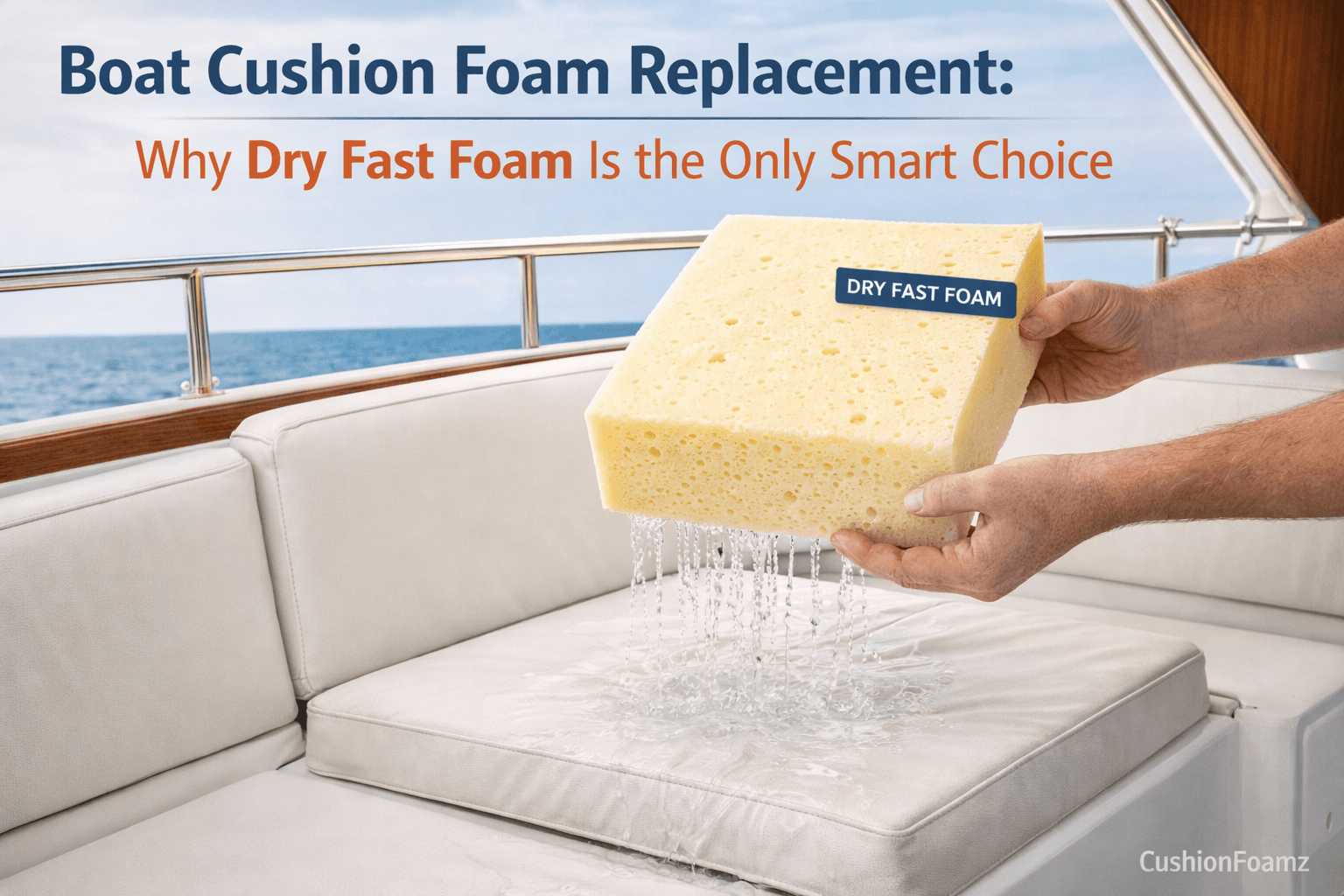
When water hits Dry Fast foam, it passes straight through. There are no cell walls to trap it. Gravity pulls the water down and out the bottom of the cushion. The foam dries in minutes rather than days — because there is nothing holding the water in the first place.
Key Properties of Dry Fast Foam
| Property | Performance |
|---|---|
| Water handling | Drains instantly through the open-cell structure |
| Dry time | Minutes, not days |
| Mold/mildew | Built-in antimicrobial protection |
| UV resistance | Does not degrade from sun exposure |
| Salt water | Fully resistant — no hydrolysis |
| Density | 1.8 lb/ft³ |
| Firmness options | Soft, medium, or firm |
| Temperature range | Performs in freezing to extreme heat |
| CertiPUR-US | Yes — certified safe |
This is the same foam specified by professional marine upholsterers, yacht builders, and boat restoration shops. It is the industry standard for a reason — nothing else comes close in wet environments.
Where to Use Dry Fast Foam on Your Boat
Every cushion surface that is exposed to the elements — or could potentially get wet — should use Dry Fast foam. Here is a breakdown by location:
Topside / Cockpit Seating
Helm seats, companion seats, cockpit benches, and stern settees. These are fully exposed to spray, rain, and sun. Dry Fast foam is mandatory here. Standard foam in these locations will fail within one season.
Bow Cushions and Sun Pads
The most exposed cushions on any boat. They catch every wave, every rain shower, and bake in direct sun all day. Dry Fast foam handles all of this without degradation.
Flybridge Seating
Elevated seating with maximum weather exposure. Dry Fast foam with proper marine-grade covers is the only combination that survives long-term at this location.
Below-Deck Berths and Sleeping Areas
This is where the choice gets interesting. V-berths, quarter berths, and cabin sleeping areas are enclosed and technically sheltered from direct weather. Many boat owners use indoor HR foam for below-deck berths because it is more comfortable for sleeping — the higher density (2.8 lb/ft³) and superior cushioning make a real difference over a full night.
However, if your cabin has any condensation issues, if the berth cushions get damp from humidity, or if you leave the boat unattended with hatches closed for extended periods, Dry Fast foam is the safer choice below deck as well. If you want to learn more about the tradeoffs between indoor and outdoor foam, our indoor vs. outdoor foam comparison covers every scenario.
Dinette Seating
Boat dinettes are below deck but frequently exposed to spills, wet gear thrown on the seats, and general marine humidity. Dry Fast foam is recommended for durability, though HR foam works if the cabin stays truly dry.
How to Measure Boat Cushions
Boat cushions are notorious for irregular shapes. Unlike sofa cushions that are mostly rectangles and T-shapes, marine cushions often follow hull contours with curves, angles, and tapered edges.
For Regular Shapes (Rectangular Bench Seats, Helm Chairs)
Use the same seam-to-seam measuring approach described in our cushion measuring guide. Remove the old cover, lay it flat, and measure width, depth, and thickness from the inside seams.
For Irregular Shapes (V-Berths, Bow Cushions, Hull-Contour Pieces)
The most reliable method is a paper template:
- Lay butcher paper, kraft paper, or taped-together newspaper sheets over the cushion surface or the platform where the cushion sits.
- Trace the outline with a marker, pressing into every corner and curve.
- Cut out the template and verify it fits the space correctly.
- Label each template with: which cushion it is (e.g., "port V-berth aft section"), thickness, and any notes about tapering or beveling.
- Photograph each template next to a tape measure for scale.
For standard shapes, use our online configurator to select your shape, enter dimensions, and see instant pricing. For complex marine shapes, contact our team with your templates and measurements and we will provide a custom quote.
V-Berth Measurements
V-berths are the most common complex shape on boats. They typically require two to four separate foam pieces that fit together like a puzzle in the tapered bow compartment. Measure each section independently:
- Length of each section along the hull side
- Width at the widest point and the narrowest point (V-berths taper)
- Thickness (typically three to six inches for sleeping comfort)
- Angle of the taper between the wide and narrow ends
Choosing Firmness for Boat Cushions
Dry Fast foam is available in three firmness levels. Your choice depends on the application:
Soft — Best for backrest cushions where you want to lean into something giving. Also suitable for occasional sleeping surfaces on smaller boats where every bit of cushioning matters.
Medium — The all-around choice. Works for most seating applications including helm chairs, bench seating, and dinettes. Provides a comfortable balance of support and give.
Firm — Best for high-use seating that needs to support significant weight without bottoming out. Also recommended for thin cushions (under three inches) where firmer foam prevents you from feeling the hard surface beneath. For guidance on selecting firmness based on body weight, see our foam density and firmness guide.
For cushions that double as sleeping surfaces (V-berths, convertible dinettes), medium firmness provides the best balance of seating support during the day and sleeping comfort at night.
How to Order Boat Cushion Foam
Standard Shapes
- Go to the CushionFoamz configurator and select Outdoor & Marine Foam.
- Choose your shape — rectangle, T-shape, L-shape, or circle.
- Enter your dimensions.
- Select your firmness preference (soft, medium, or firm).
- See your instant price and place your order.
Outdoor Dry Fast foam is priced at $0.14 per cubic inch. A typical helm seat cushion (18 × 18 × 3 inches) runs about $136. A full set of cockpit bench cushions for a mid-size boat typically ranges from $300 to $600 depending on dimensions.
Custom / Irregular Shapes
For complex marine shapes that do not fit our standard configurator options, reach out to our team with your paper templates, photos, and measurements. We will provide a custom quote, typically within one business day.
Shipping
Most orders ship within two to five business days. Free shipping on orders over $199 — which most boat cushion projects exceed. We ship to all fifty states, including Hawaii and Alaska.
Installation Tips for Marine Cushions
Removing Old Foam
Strip out all old foam completely. If the old foam has mold, dispose of it in sealed bags to prevent spreading spores in the cabin. Clean the cushion covers thoroughly before inserting new foam — wash in hot water with a mildew-specific detergent if the covers are machine-washable.
Fitting Dry Fast Foam into Covers
Dry Fast foam has a slightly different texture than standard polyurethane — it is more open and can grip fabric. The plastic-bag trick works well here: wrap the foam in a thin plastic bag (a garbage bag works), slide it into the cover, position it correctly, then pull the plastic out through the zipper opening. This is the same technique we describe in our couch cushion replacement guide.
No Batting Needed for Marine Applications
Unlike indoor cushions where Dacron batting adds softness and a rounded look, marine cushions typically skip the batting. Batting absorbs and retains moisture — which defeats the purpose of using Dry Fast foam. The foam should be in direct contact with the cover fabric so water can drain freely.
Marine Cover Considerations
Dry Fast foam works best with marine-grade cover fabrics that are also water-permeable or quick-drying. Sunbrella marine canvas, vinyl with drainage grommets, or mesh-bottom covers allow water to move through the entire cushion system, not just the foam. Solid vinyl covers without drainage holes will trap water on top of the foam, negating much of the Dry Fast advantage.
Dry Fast Foam vs. Closed-Cell Marine Foam
Some marine suppliers sell closed-cell foam (like cross-linked polyethylene) for boat cushions. Closed-cell foam does not absorb water, which sounds ideal — but there are significant downsides:
Comfort: Closed-cell foam is dense, rigid, and not designed for seating comfort. It feels like sitting on a firm rubber mat. Reticulated Dry Fast foam provides genuine cushioning and seating comfort.
Drainage: Closed-cell foam repels water but does not drain it. Water pools on the surface and inside the cover. Dry Fast foam lets water pass through and out.
Breathability: Closed-cell foam traps heat and does not allow air circulation. On a hot day, closed-cell marine cushions become uncomfortably warm. Dry Fast foam breathes freely.
For structural applications (flotation, insulation, fender material), closed-cell foam is appropriate. For seating and sleeping comfort, Dry Fast reticulated foam is the clear winner.
Frequently Asked Questions
How long does Dry Fast foam last on a boat?
In typical marine conditions, Dry Fast foam lasts five to eight years. Boats that are stored properly during off-season and have quality covers can see longer life. This compares favorably to standard foam, which often fails within one to two seasons in marine environments.
Can I use Dry Fast foam for my V-berth mattress?
Yes, and many boat owners do. For V-berths used primarily for sleeping, some owners prefer indoor HR foam for its superior comfort — especially for extended cruising. If your V-berth stays dry, HR foam at 2.8 lb density provides a significantly better sleeping surface. If moisture is a concern, Dry Fast in medium firmness is a solid compromise. Our RV and camper cushion guide covers similar sleeping-vs-seating tradeoffs that apply to marine berths.
Should I replace all boat cushions at once?
If your existing cushions are all the same age and showing similar wear, yes — replacing them simultaneously ensures uniform comfort and appearance. If only certain cushions are damaged (typically the most exposed topside cushions), you can replace those individually and address others as needed.
Will Dry Fast foam work in freezing temperatures?
Absolutely. Because the foam does not absorb water, there is no freeze-thaw damage. Boat owners in northern climates routinely leave Dry Fast cushions aboard during winter storage without any issues.
Does Dry Fast foam come in different thicknesses?
Yes. You specify your desired thickness when ordering. Common marine cushion thicknesses range from two inches for thin seat pads to six inches for sleeping berths. We cut to any thickness you need, and our foam configurator calculates pricing instantly based on your exact dimensions.
The Bottom Line
If your boat has standard polyurethane foam in the cushions, replacing it with Dry Fast reticulated foam is one of the highest-value upgrades you can make. You eliminate the waterlogging, mold, weight, and odor problems permanently — not temporarily. And you get cushions that perform exactly as they should in a marine environment: draining instantly, drying fast, and staying comfortable season after season.
Ready to upgrade your boat cushions? Build your custom marine foam order →
Explore our full boat and marine cushion page for more information on marine foam applications, or visit our How It Works page to see the ordering process from start to finish.