Foam Density and Firmness Explained: The Complete Cushion Buyer's Guide
If you have ever shopped for replacement cushion foam, you have run into a wall of confusing numbers. Density. Firmness. ILD. Compression deflection. Pounds per cubic foot. Some sellers list all of these, some list none, and almost nobody explains what they actually mean for you — the person who just wants a comfortable sofa.
This guide cuts through the jargon. By the end, you will understand exactly what foam density and firmness are, how they interact, why density is the number you should care about most, and which specifications to choose for your specific cushion project. Bookmark this page — it is the reference you will come back to every time you order foam.
Density and Firmness Are Not the Same Thing
This is the most common misconception in the foam industry, and it leads to more bad purchasing decisions than any other misunderstanding.
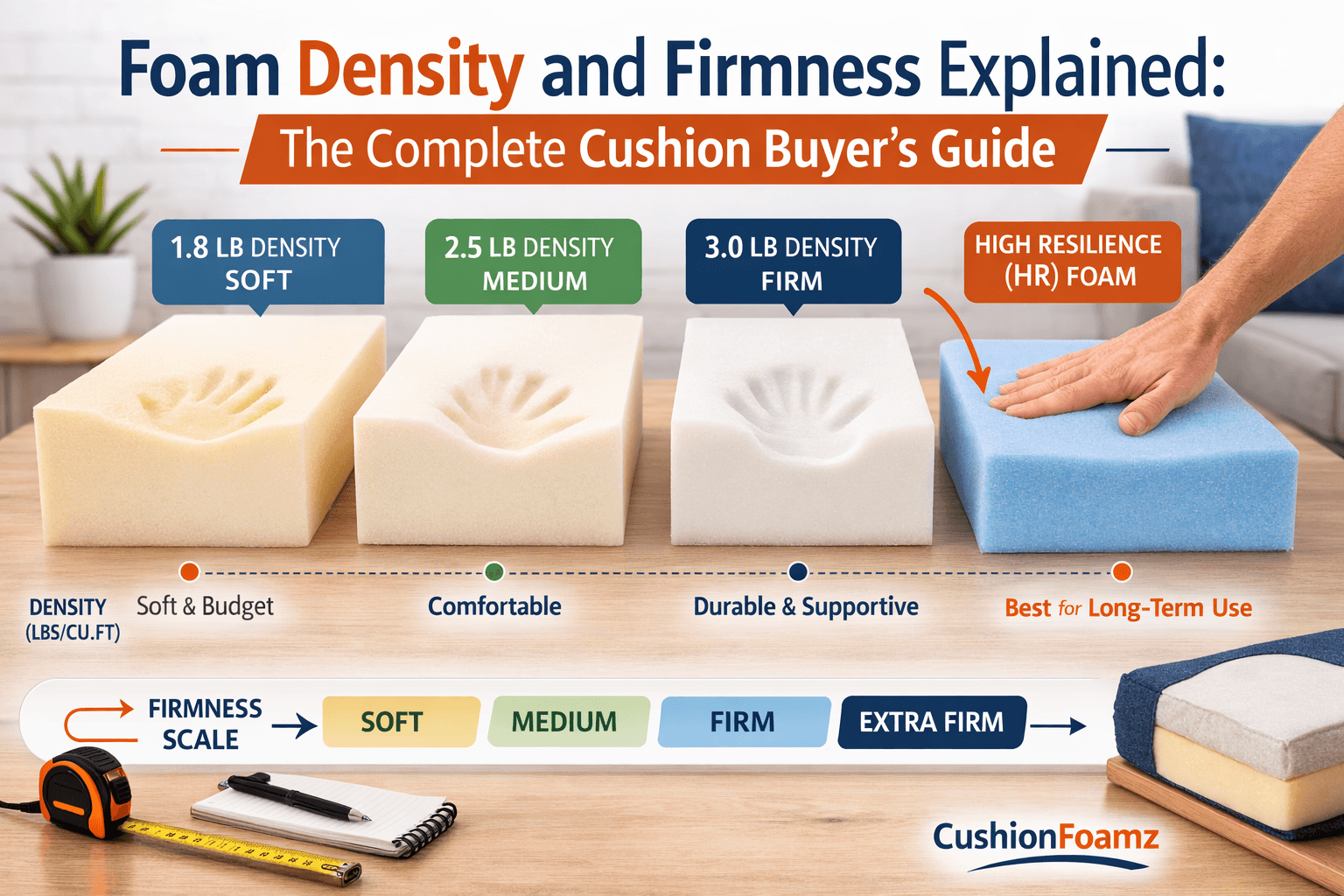
Density measures how much foam material is packed into a given volume. It is expressed in pounds per cubic foot (lb/ft³). A one-cubic-foot block of 2.8 lb foam literally weighs 2.8 pounds.
Firmness measures how much force is required to compress the foam. It describes how the foam feels — soft, medium, or firm — when you sit on it.
These are independent variables. You can have high-density foam that feels soft, and low-density foam that feels firm. Density tells you how long the foam will last. Firmness tells you how it will feel. Both matter, but they answer different questions.
Think of it this way: density is the quality of the foam, and firmness is the feel of the foam. A firm but low-density foam will feel supportive at first but flatten out within a year or two. A soft but high-density foam will feel plush on day one and still feel plush on year ten.
Understanding Foam Density
What the Numbers Mean
Foam density is the weight of one cubic foot of foam material, measured in lb/ft³:
| Density Range | Quality Tier | Typical Lifespan | Common Applications |
|---|---|---|---|
| 1.0–1.5 lb/ft³ | Low (budget) | 1–3 years | Throw pillows, packaging, craft projects |
| 1.5–1.8 lb/ft³ | Medium-low (mass market) | 2–5 years | Most retail sofas, guest room furniture |
| 1.8–2.2 lb/ft³ | Medium (decent quality) | 4–7 years | Better retail furniture, occasional-use seating |
| 2.5–2.8 lb/ft³ | High (professional grade) | 8–15 years | Daily-use sofas, commercial seating |
| 3.0+ lb/ft³ | Premium | 12–20+ years | Heavy commercial, medical, industrial |
Why Density Matters More Than You Think
Here is the uncomfortable truth about the furniture industry: most sofas sold in America use 1.5 to 1.8 lb/ft³ foam. This includes sofas that cost $1,500, $2,500, or even $4,000. Manufacturers use lower-density foam because it costs less, and most consumers do not know what density their cushions contain until the foam starts sagging three to five years later.
When you replace your couch cushion foam yourself, you get to choose the density. This is the single biggest upgrade you can make. Moving from 1.5 lb manufacturer foam to 2.8 lb professional-grade foam does not just extend the lifespan — it transforms the sitting experience. The foam distributes your weight more evenly, resists body impressions, and returns to its original shape thousands of more times before degrading.
Our indoor cushion foam is 2.8 lb/ft³ high-resiliency foam — the same grade professional upholsterers use for custom furniture and restoration work. At that density, you are getting foam that will outlast most sofas two or three times over.
Density and Price
Higher density foam costs more because it contains more raw material per cubic foot. Our indoor HR foam at 2.8 lb/ft³ runs $0.07 per cubic inch. Budget foam at 1.5 lb/ft³ might cost $0.03 to $0.04 per cubic inch from other suppliers — but you will replace it two to three times in the span that quality foam lasts, making the per-year cost actually higher for cheap foam.
Understanding Foam Firmness
ILD: The Firmness Measurement
Firmness is technically measured using the Indentation Load Deflection (ILD) test. A circular plate pushes into a foam sample until it compresses 25 percent of its thickness, and the force required (in pounds) is the ILD number.
| ILD Range | Firmness Feel | Best For |
|---|---|---|
| 8–15 | Very soft | Pillow tops, backrest cushions, comfort layers |
| 15–25 | Soft | Back cushions, light-use seat cushions, mattress toppers |
| 25–35 | Medium | Everyday seating, most sofa cushions |
| 35–45 | Medium-firm | Daily-use sofas, dining chairs, office seating |
| 45–55 | Firm | Heavy-use seating, people over 200 lbs |
| 55+ | Very firm | Industrial, support, rarely used alone for seating |
How Firmness Affects Your Experience
Firmness is highly personal. What feels perfectly supportive to one person feels like sitting on concrete to another. That said, here are some practical guidelines:
For sofa seat cushions: Medium-firm (ILD 35–45) is the industry standard and works for the widest range of body types. This is the firmness of our indoor HR foam, and it is what professional upholsterers recommend for daily-use furniture.
For back cushions: One step softer than the seat cushion (ILD 20–30) creates a comfortable contrast — firm support where you sit, softer give where you lean.
For heavier individuals: Firmer foam prevents bottoming out. If you weigh over 200 pounds, medium-firm to firm (ILD 40–55) provides proper support without the foam compressing flat under your weight. We cover this in detail in our foam guide for heavier individuals.
For dining and occasional seating: Medium (ILD 25–35) works well for thinner cushions (one to three inches) on chairs where you sit for shorter periods.
How Density and Firmness Work Together
Here is where the practical knowledge comes together. You need to think about density and firmness as a matrix, not as a single scale:
| Low Density (1.5 lb) | Medium Density (2.0 lb) | High Density (2.8 lb) | |
|---|---|---|---|
| Soft | Collapses quickly, very short life | Comfortable short-term, moderate life | Plush and durable — great for back cushions |
| Medium-Firm | Feels okay initially, flattens in 1–3 years | Decent balance for light use | The sweet spot for daily-use sofa seats |
| Firm | Feels stiff but still degrades fast | Suitable for dining chairs | Commercial-grade, heavy-use seating |
The ideal combination for most sofa cushion replacements is high density (2.5–2.8 lb/ft³) with medium-firm feel. You get the best of both worlds: foam that feels supportive and comfortable from day one, and that maintains that exact feel for a decade or more.
This is exactly what our indoor cushion foam delivers at 2.8 lb/ft³ density in a medium-firm firmness.
High Resilience vs. Conventional Polyurethane
Not all foam at the same density performs equally. The manufacturing process matters enormously, and this is where the distinction between high-resilience (HR) foam and conventional polyurethane foam becomes important.
Conventional polyurethane foam has a relatively uniform cell structure. When compressed, all cells deform at roughly the same rate. It provides adequate support but lacks the responsiveness that makes sitting feel natural.
High-resilience (HR) foam is manufactured using a cold-cure process that creates a more varied, open-cell structure. When compressed, different cells respond at different rates — smaller cells compress first for initial softness, then larger cells engage for deeper support. This is why HR foam feels both cushioning and supportive simultaneously.
HR foam also has a higher rebound rate (it bounces back faster) and distributes weight more evenly across the seating surface. The result: fewer pressure points, less body impression, and longer shape retention.
For a deeper technical comparison, see our high resilience foam vs. high density foam guide. The short version: for any seating application where comfort and longevity matter, HR foam is the superior choice.
What About Outdoor Foam Density?
Our outdoor Dry Fast reticulated foam has a density of 1.8 lb/ft³. In an apples-to-apples comparison with indoor foam, that sounds lower quality — but outdoor foam is an entirely different material with different performance characteristics.
Dry Fast foam sacrifices density for its open-cell structure that allows water to drain through. That open structure means less material per cubic foot (hence the lower density number), but the foam is specifically engineered to perform in conditions where standard foam would fail completely. Comparing the density of indoor and outdoor foam directly is like comparing the weight of a raincoat to a winter coat — they serve different purposes.
For more on when to use each foam type, see our indoor vs. outdoor foam comparison.
Recommendations by Application
Here are our specific density and firmness recommendations for the most common cushion projects:
| Application | Recommended Density | Recommended Firmness | Our Product |
|---|---|---|---|
| Sofa seat cushions (daily use) | 2.5–2.8 lb/ft³ | Medium-firm | Indoor HR Foam |
| Sofa back cushions | 2.0–2.8 lb/ft³ | Soft to medium | Indoor HR Foam |
| Dining chairs (1–3″ pads) | 2.0–2.8 lb/ft³ | Medium to firm | Indoor HR Foam |
| Window seats and benches | 2.5–2.8 lb/ft³ | Medium-firm | Foam Cut to Size |
| RV/camper seating | 2.5–2.8 lb/ft³ | Medium-firm | Indoor HR Foam |
| Patio furniture | 1.8 lb/ft³ (Dry Fast) | Medium | Outdoor Foam |
| Boat cushions | 1.8 lb/ft³ (Dry Fast) | Medium to firm | Marine Foam |
| Headboards | 2.0–2.8 lb/ft³ | Soft to medium | Indoor HR Foam |
How to Check What Foam Is Already in Your Furniture
Curious about the foam quality in your current sofa? Here are two quick methods:
The weight test: Remove a cushion insert and weigh it on a bathroom scale. Calculate the volume (length × width × thickness in inches, then divide by 1,728 to convert to cubic feet). Divide the weight in pounds by the volume in cubic feet. That gives you the approximate density.
The recovery test: Press your fist firmly into the center of the cushion for ten seconds, then release. High-density, high-resilience foam will spring back to shape within one to two seconds. Medium-density foam takes three to five seconds. Low-density foam takes longer or does not fully recover.
If your foam scores poorly on these tests, it is time for a replacement. Our complete replacement guide walks you through the entire process, and our measuring guide ensures you get the dimensions right.
Frequently Asked Questions
Is 2.8 lb foam too firm for a sofa?
Density does not determine firmness. Our 2.8 lb foam has a medium-firm feel that is comfortable for the vast majority of people. It will feel slightly firmer than what most retail sofas ship with — but that is because most retail foam is too soft (low density), not because your old foam was a better firmness. After a week of break-in, most customers describe it as perfectly supportive.
Can I get softer foam in the same high density?
Our 2.8 lb indoor foam comes in a medium-firm feel that is optimized for seat cushions. For back cushions or applications where you want a softer feel, the same foam at a reduced thickness naturally feels softer because there is less material to compress through.
What foam density do high-end furniture brands use?
Brands like Restoration Hardware, Crate & Barrel, and Pottery Barn typically use 1.8 to 2.2 lb/ft³ foam. Custom furniture makers and professional upholsterers use 2.5 to 2.8 lb/ft³. Our foam matches the professional grade — meaning your replacement cushions will objectively outperform what most premium furniture ships with.
Does higher density mean heavier cushions?
Yes, but the weight difference is modest. A typical 24 × 24 × 5 inch sofa cushion in 2.8 lb foam weighs about five pounds. The same cushion in 1.5 lb foam weighs about 2.7 pounds. You will notice a slight difference when moving cushions, but it is negligible during daily use.
The Bottom Line
When shopping for replacement cushion foam, density is the number that predicts quality and longevity. Firmness is the number that predicts feel. You want both to be right — but if you have to prioritize, always choose higher density. Firmness is a preference that varies by person. Density is an objective measure of how long the foam will perform.
For most sofa cushion replacement projects, 2.8 lb/ft³ high-resiliency foam in medium-firm is the professional standard — and it is exactly what we carry.
Ready to order? Build your custom cushion in our configurator →
For more guidance on choosing the right foam for your specific project, explore our FAQ page or browse our full range of upholstery foam options.