High Resilience Foam vs. High Density Foam: Which Is Better for Your Cushions?
If you have been researching replacement foam for your sofa or furniture cushions, you have almost certainly encountered two terms that sound like they mean the same thing but do not: high resilience (HR) foam and high density (HD) foam. The naming is genuinely confusing, and most foam sellers do a poor job of explaining the difference. Some use the terms interchangeably, which makes things worse.
Here is the core distinction: high density describes how heavy the foam is per cubic foot. High resilience describes how the foam behaves when compressed. One is a measurement of material quantity. The other is a measurement of material performance. A foam can be high density without being high resilience, and understanding this difference is the key to choosing cushion foam that actually performs well long-term.
This guide breaks down both properties, compares them head-to-head, and gives you a clear recommendation for every common cushion application.
What Is High Density (HD) Foam?
Density measures the weight of foam per cubic foot, expressed in lb/ft³. A cube of foam measuring 12 × 12 × 12 inches is weighed, and that weight is the density rating.
High density foam generally refers to foam with a density of 1.8 lb/ft³ or higher. In the furniture industry, the most common HD foam ranges from 1.8 to 2.2 lb/ft³. It is the workhorse of mass-market furniture manufacturing — the standard foam you find inside the vast majority of retail sofas, dining chairs, and commercial seating.
HD foam is conventional polyurethane made through a standard hot-cure manufacturing process. The resulting cell structure is relatively uniform — all cells are roughly the same size and respond to compression at the same rate.
HD Foam Characteristics
- Density range: Typically 1.8–2.2 lb/ft³
- Manufacturing: Standard hot-cure polyurethane process
- Cell structure: Uniform cell size
- Feel: Supportive but can feel flat or monotone under extended sitting
- Recovery: Moderate — returns to shape but not as quickly as HR foam
- Lifespan: 4–7 years under daily use
- Cost: Lower than HR foam at the same density
- Common in: Retail furniture, office seating, dining chairs, guest room sofas
HD foam is a perfectly adequate material for many applications. It is not bad foam. But it is not the best foam available, and for applications where comfort and longevity are priorities — like a sofa your family uses every day — there is a meaningfully better option.
What Is High Resilience (HR) Foam?
High resilience foam is a specific category of polyurethane foam manufactured using a cold-cure process that creates a fundamentally different internal structure than conventional HD foam.
The cold-cure process produces foam with variable cell sizes — a mix of smaller and larger cells distributed throughout the material. This is the key performance difference. When you sit on HR foam, the smaller cells compress first, providing initial softness and give. As you sink deeper, the larger cells engage, providing progressive support that prevents bottoming out. The result is a cushion that feels both soft on contact and deeply supportive under sustained load.
Resilience itself is measured by the ball rebound test: a steel ball is dropped onto the foam from a standard height, and the percentage of the original height it bounces back to is the resilience rating. Conventional foam typically rebounds 40 to 50 percent. High-resilience foam rebounds 60 percent or higher — meaning it returns energy more efficiently, which translates to a springier, more responsive feel and faster shape recovery.
HR Foam Characteristics
- Density range: Typically 2.5–3.0+ lb/ft³
- Manufacturing: Cold-cure polyurethane process
- Cell structure: Variable cell sizes (mixed small and large)
- Feel: Progressive support — soft initial contact, firm deep support
- Recovery: Fast — springs back immediately to original shape
- Lifespan: 8–15 years under daily use
- Cost: Higher than HD foam, but lower cost-per-year over the foam's lifetime
- Common in: Professional upholstery, custom furniture, high-end restoration, premium seating
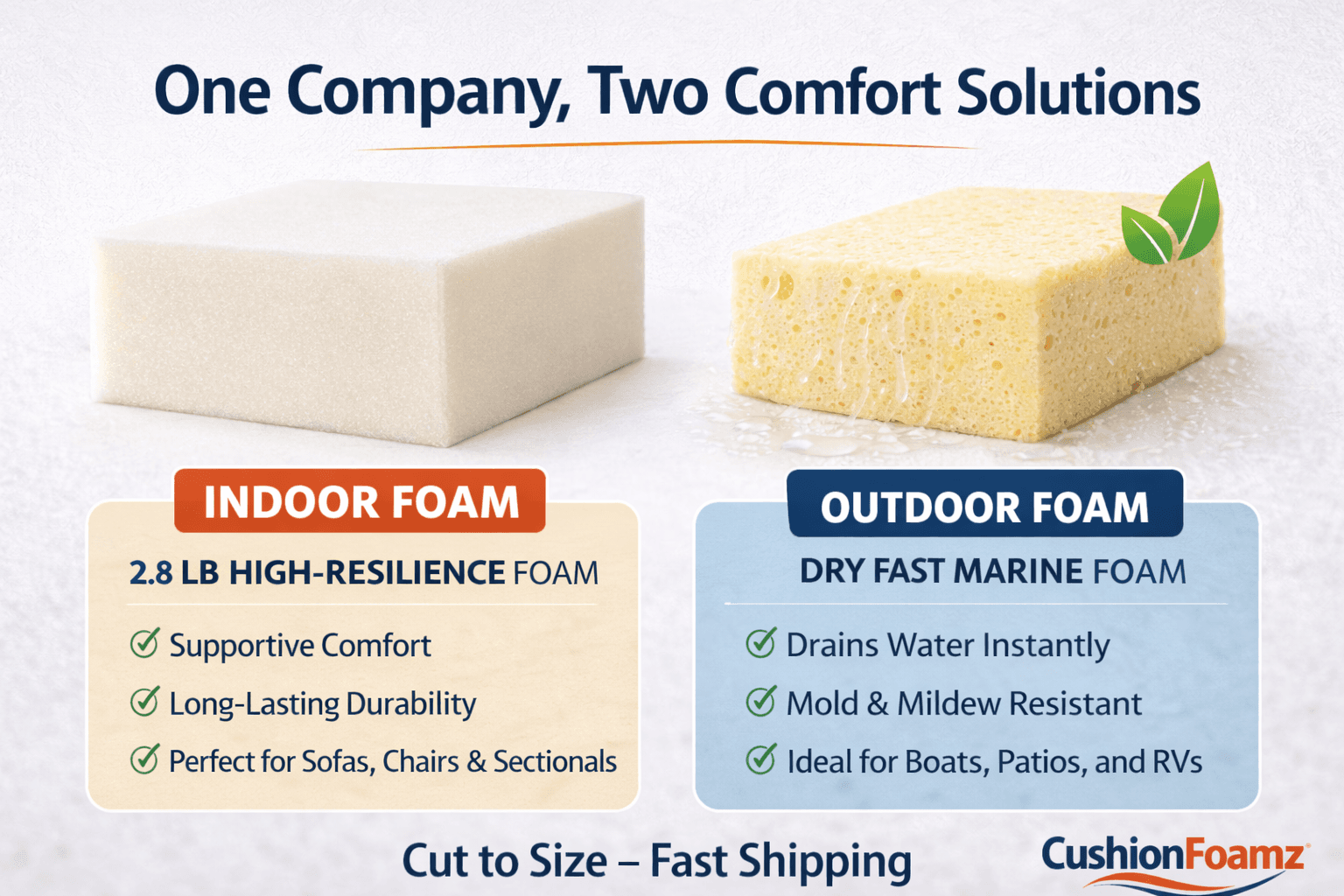
At CushionFoamz, our indoor cushion foam is 2.8 lb/ft³ high-resilience cold-cure foam. It is both high density (2.8 lb) and high resilience (cold-cure process with variable cell structure). This combination delivers the best of both properties. For the full breakdown of how density affects quality and lifespan, see our foam density and firmness guide.
Head-to-Head Comparison
| Property | High Density (HD) Foam | High Resilience (HR) Foam |
|---|---|---|
| Density | 1.8–2.2 lb/ft³ | 2.5–3.0+ lb/ft³ |
| Manufacturing | Hot-cure (conventional) | Cold-cure (advanced) |
| Cell structure | Uniform | Variable (mixed sizes) |
| Initial feel | Consistent firmness throughout | Soft on contact, firm on depth |
| Support | Good, but uniform | Progressive — adapts to load |
| Rebound/resilience | 40–50% | 60%+ |
| Shape recovery | Moderate (3–5 seconds) | Fast (1–2 seconds) |
| Body impression resistance | Moderate | Excellent |
| Weight distribution | Adequate | Superior — fewer pressure points |
| Lifespan (daily use) | 4–7 years | 8–15 years |
| Cost per unit | Lower | Higher |
| Cost per year of use | Higher (replace sooner) | Lower (lasts 2–3x longer) |
| Best for | Occasional-use furniture, guest rooms, dining chairs | Daily-use sofas, family rooms, any furniture where comfort matters |
The Comfort Difference You Can Actually Feel
The technical differences between HD and HR foam translate into real, perceptible comfort differences:
First 10 Seconds: The Sit-Down Moment
When you sit on HD foam, you feel a uniform resistance — the foam pushes back evenly at every depth of compression. It is supportive but one-dimensional.
When you sit on HR foam, you feel a two-stage response. The initial contact is softer as the small cells compress, creating a welcoming give. As you settle deeper, the larger cells engage and you feel firm, stable support underneath. This progressive feel is what makes HR foam feel natural and comfortable — your body does not fight the foam and the foam does not fight your body.
After 30 Minutes: The Extended Sit
This is where the difference becomes most apparent. HD foam under sustained load begins to create a body impression — the cells under your heaviest pressure points compress more than surrounding cells, creating an uneven surface. You start to feel the frame or springs beneath the foam, and you shift your position frequently to redistribute the load.
HR foam resists body impressions significantly better because the variable cell structure distributes load across a wider area. The foam adapts to your weight without concentrating pressure. You sit longer without discomfort and without feeling the need to shift.
After 3 Years: The Longevity Test
After three years of daily use, HD foam has lost 20 to 40 percent of its original firmness and height. The cells have permanently deformed in the most-used areas. The cushion has a visible sag and no longer returns to its original shape.
After three years, HR foam has lost less than 10 percent of its original properties. The variable cell structure degrades more evenly, and the cold-cure molecular bonds resist permanent deformation far longer than conventional polyurethane. The cushion still looks and feels like it did in the first months of use.
For a guide on recognizing when your foam has reached the end of its useful life, see our post on how long cushion foam lasts.
When HD Foam Is the Right Choice
HD foam is not always the wrong choice. There are legitimate applications where it makes sense:
Guest room furniture — Seating used occasionally does not need the longevity advantage of HR foam. HD foam at 1.8–2.0 lb/ft³ provides adequate comfort for light use.
Dining chairs with thin cushions — A 1 to 2 inch seat pad on a dining chair bears weight for short periods. HD foam works fine here and costs less.
Back cushions — Backrest cushions bear far less weight than seat cushions. HD foam in the back paired with HR foam in the seats is a reasonable cost-saving strategy.
Budget-constrained projects — If upfront cost is the dominant factor and you accept a shorter lifespan, HD foam gets you functional cushioning at a lower price point.
Temporary furniture — If the sofa is a stop-gap while you save for something else, HD foam handles the interim duty at lower cost.
When HR Foam Is the Clear Winner
For any application where you want the cushion to last and feel great for years, HR foam is the superior choice:
Daily-use sofas and sectionals — Your living room sofa is the most demanding seating application in your home. HR foam is designed for exactly this level of sustained, repeated use. Our couch cushion replacement guide walks you through the full process of upgrading.
Family room furniture — High-traffic rooms with kids, pets, and constant use need foam that can absorb the punishment without premature degradation.
Furniture you love and want to keep — If you have a sofa with great bones, quality fabric, and sentimental value, HR foam is the investment that keeps it alive for another decade.
Heavier individuals — People over 200 pounds create more compression force with every sit. HR foam's progressive support and superior weight distribution prevent bottoming out and extend usable life. Our foam guide for heavier individuals covers this in detail.
Commercial seating — Restaurants, hotels, waiting rooms, and offices where seating sees heavy daily traffic from multiple users. The durability advantage of HR foam is amplified in commercial environments.
The Cost Math
HR foam costs more upfront. But foam is not a single-purchase decision — it is a cost-per-year decision.
HD foam example: A set of three sofa cushions in 2.0 lb HD foam might cost $50 to $80 and last four to five years. Over fifteen years, you replace it three times: $150 to $240 total.
HR foam example: The same cushion set in 2.8 lb HR foam costs $80 to $140 and lasts ten to fifteen years. Over fifteen years, you replace it once: $80 to $140 total.
HR foam costs less over the life of the furniture while providing superior comfort every day. This is why professional upholsterers — people who build and restore furniture for a living — overwhelmingly choose HR foam for seat cushions.
Our indoor HR foam is priced at $0.07 per cubic inch. Calculate your exact project cost in our foam configurator.
What About Memory Foam?
Memory foam (viscoelastic polyurethane) is a separate category entirely. It is temperature-sensitive, conforms slowly to your body shape, and returns to shape slowly after pressure is removed. It is excellent for mattresses where you want body-conforming sleep support, but it has significant drawbacks for seating cushions:
- Slow recovery — When you stand up from a memory foam cushion, it holds your body impression for seconds before slowly recovering. This makes the seat look unkempt and means the next person sits into your impression.
- Temperature sensitivity — Memory foam feels firmer in cold rooms and softer in warm rooms. Seating comfort varies with ambient temperature.
- Bottoming out — Without a firmer support base, memory foam compresses fully under seated weight and you feel the frame beneath.
- Heat retention — Memory foam traps body heat, which can be uncomfortable during extended sitting.
Memory foam can work as a thin comfort layer on top of a firmer foam base (a one-inch memory foam topper on a four-inch HR foam seat), but it should not be the sole foam in a seating cushion.
Our Recommendation
For any seating cushion that matters — your daily-use sofa, your favorite reading chair, the sectional where your family gathers every evening — high-resilience foam is the right choice. It costs more per cubic inch but less per year, it feels better on day one and year ten, and it is what the professionals who build furniture for a living choose for their own projects.
Our 2.8 lb/ft³ cold-cure HR foam is the exact foam grade used by professional upholsterers. It is CertiPUR-US certified, precision-cut to your dimensions, and available in every standard cushion shape through our configurator.
Ready to upgrade? Build your custom cushion →
For more guidance, start with our complete replacement guide or browse our custom sofa cushion options.