Sectional Sofa Cushion Replacement: A Complete Guide for Every Configuration
Sectional sofas are the most popular seating configuration in American living rooms — and they are also the most complicated when it comes to foam replacement. Unlike a standard three-cushion sofa where every cushion is roughly the same size, sectionals have multiple cushion types: standard seats, corner pieces, chaise sections, armless middles, wedge-shaped connectors, and configurations that vary dramatically from model to model.
The good news: the foam replacement process is fundamentally the same as any sofa. The complexity is in the measuring and planning, not the execution. Once you have accurate dimensions for every cushion in your sectional, ordering and installation is straightforward. This guide walks through every sectional configuration you will encounter and shows you how to approach each one.
Why Sectional Foam Replacement Is Worth It
Sectionals represent a significant furniture investment — typically $1,500 to $6,000 depending on size and brand. Replacing one is a major purchase and logistical headache (try getting a five-piece sectional through a narrow hallway). The frames on quality sectionals last fifteen to twenty years. The foam does not.
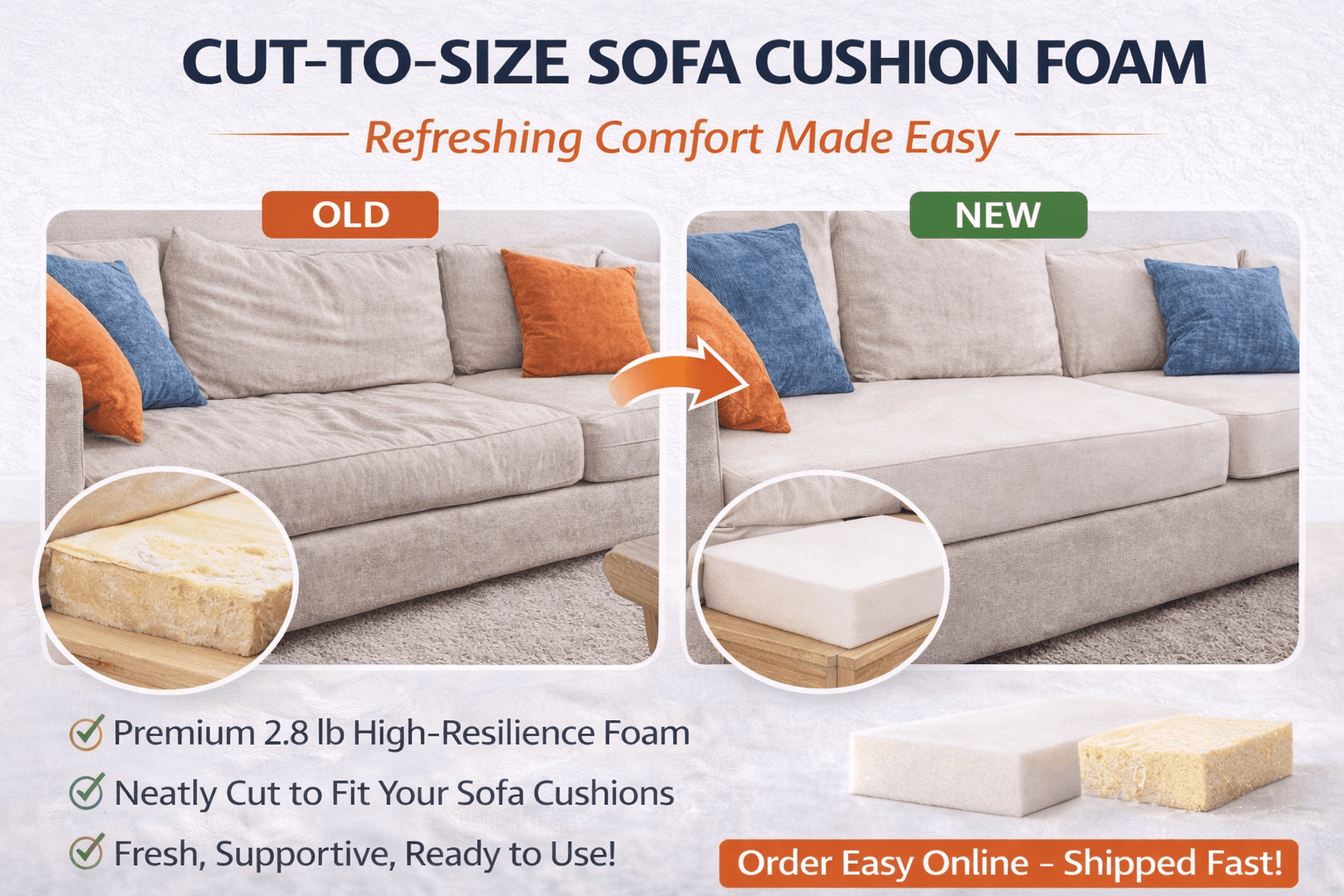
Complete foam replacement for a five to seven piece sectional typically costs $200 to $500 in custom-cut 2.8 lb HR foam — roughly 5 to 15 percent of the replacement cost. The foam will outlast the original factory foam by a factor of two to three because you are upgrading to professional-grade material. For the full cost analysis, see our sofa foam replacement cost guide.
Sectional Cushion Types
Standard Seat Cushions
The most common cushion type across all sectional configurations. These are rectangular or T-shaped cushions that sit on armless or single-arm sections. Measure and order these exactly as you would for a standard sofa — follow our cushion measuring guide for the step-by-step process.
Corner / Wedge Seat Cushions
The corner piece connects two sections at a 90-degree angle. The seat cushion is typically square or nearly square, often deeper than the standard seats because the corner section is deeper front-to-back.
Measuring tip: Corner cushion covers are usually square. Measure all four sides (seam to seam) and note if any side is slightly different. The corner cushion is often the thickest cushion in the sectional because it bears the most concentrated wear — people gravitate to the corner seat.
Chaise Section Cushions
The chaise is the extended section where you can stretch out your legs. The chaise cushion is typically one long piece that covers the entire chaise surface — it is wider and longer than a standard seat cushion.
Measuring tip: Chaise cushions often have an irregular shape — wider at the seating end and narrower at the foot end, or with a beveled front edge. If the shape is not a clean rectangle, make a paper template by tracing the empty cover laid flat. Use our configurator for rectangular chaise cushions, or contact us for irregular shapes.
Common chaise dimensions: 36 to 40 inches wide × 60 to 72 inches long × 5 to 6 inches thick. These are the largest individual cushions in a sectional and represent the most significant foam cost per piece — typically $60 to $120 depending on dimensions.
Armless Middle Sections
Sectionals with modular or extended configurations may include armless middle seats that sit between the corner and end sections. These cushions are identical to standard rectangular seat cushions — measure width, depth, and thickness from the cover.
Back Cushions
Sectional back cushions come in two varieties:
Loose back cushions: Removable cushions that lean against the sofa back frame. These have covers with access (zippers or sewn openings) and are measured and replaced like any removable cushion.
Attached back cushions: Cushions sewn to the sofa frame. These require opening a seam to access the foam, replacing the insert, and re-sewing the seam. A seam ripper and curved needle handle this, or a local upholsterer can do it for $15 to $30 per cushion.
Step-by-Step: Replacing All Cushions in a Sectional
Step 1: Map Your Sectional
Before measuring anything, create a sketch or take a photo of your entire sectional from above. Label each section: Left Arm, Armless Middle 1, Corner, Armless Middle 2, Right Arm Chaise (or whatever your configuration is). Number each seat cushion and back cushion.
This map becomes your order guide and prevents confusion when you have eight or more pieces of foam arriving at your door.
Step 2: Measure Every Cushion Individually
Do not assume any two cushions are the same size. Even cushions that look identical may differ by an inch or more due to manufacturing tolerances, different section positions, or asymmetric designs. Remove every cover and measure each one from seam to seam.
For each cushion, record:
- Position (which section and which cushion — e.g., "Left arm section, seat cushion")
- Width (left seam to right seam)
- Depth (front seam to back seam)
- Thickness (top seam to bottom seam)
- Shape (rectangle, T-shape, L-shape, or irregular)
For complete measuring instructions including T-shapes and L-shapes, see our measuring guide.
Step 3: Check for Consistency
After measuring all cushions, compare your numbers. Are all seat cushion thicknesses the same? They should be — different thicknesses create an uneven seating surface. If your measurements show a half-inch variation in thickness across cushions, use the most common measurement for all seat cushions to ensure a uniform height when installed.
Step 4: Order All Cushions at Once
Enter each unique cushion size into the configurator as a separate item. For cushions with identical dimensions, order multiples. Having all foam arrive together ensures you can install everything in one session and verify that all heights match.
Important: Replace all seat cushions simultaneously. Mixing new firm foam with old compressed foam creates an obvious height and firmness mismatch that looks and feels bad. Back cushions can be phased in later if budget is a concern, but seat cushions should be done as a complete set.
Step 5: Install Section by Section
Work through your sectional one section at a time, using your map to match each piece of foam to its correct cushion cover and position. The installation process is the same as any sofa cushion — fold, insert, position, zip. For the complete walkthrough, see our couch cushion replacement guide.
Matching Cushion Heights Across the Sectional
This is the detail that separates a good sectional foam replacement from a great one. Every seat cushion in the sectional should sit at the same height when installed, creating a smooth, uniform seating surface across the entire piece.
How to achieve this:
- Order all seat cushions at the same thickness.
- If adding Dacron batting, use the same wrap style on every cushion (all book wrap, or all full wrap — do not mix).
- If one section has a different seat platform height (common on chaise sections where the frame may be slightly higher or lower), adjust the foam thickness for that section to compensate.
Common Sectional Configurations and Pricing
Here are approximate foam costs for common sectional layouts using 2.8 lb HR foam at $0.07 per cubic inch:
| Configuration | Cushion Count | Approximate Foam Cost |
|---|---|---|
| 3-piece L-shaped (2 seats + corner) | 3 seat + 3 back | $120–$200 |
| 4-piece sectional (3 seats + chaise) | 4 seat + 3 back | $180–$300 |
| 5-piece sectional (4 seats + corner) | 5 seat + 5 back | $220–$380 |
| 6-piece modular (5 seats + corner) | 6 seat + 6 back | $280–$450 |
| Large U-shaped sectional | 7–9 seat + matching backs | $350–$550 |
Free shipping on orders over $199. Most sectional projects qualify.
Sectional-Specific Challenges
Mixed Wear Patterns
Sectional cushions rarely wear evenly. The "favorite seat" (usually the corner or the end nearest the TV) degrades fastest, while the least-used section may still feel adequate. Despite this, replace all seat cushions together. New foam in one position next to compressed old foam in the adjacent position creates an obvious step-down that looks worse than uniformly worn cushions.
Modular Sectionals That Rearrange
If your sectional is modular (sections disconnect and rearrange), all cushions need to be interchangeable. Order every seat cushion at identical dimensions and firmness so any cushion can go in any position regardless of how you arrange the sections.
Attached Chaise Cushions
Some chaise sections have the cushion built into the frame without a removable cover. In this case, you need to access the foam from underneath (through a dust cover) or by opening a seam on the underside. A local upholsterer can handle this if you prefer not to do it yourself.
Down-Blend Sectional Cushions
Premium sectionals from brands like Restoration Hardware, Arhaus, and some Pottery Barn lines use a foam core wrapped in a down or down-alternative envelope. When replacing the foam, work with the inner foam core — remove it from the down envelope, measure it (or measure the envelope's interior), order replacement foam, and re-insert into the down wrap before placing back in the outer cover.
Frequently Asked Questions
Can I replace just the cushions that are worst?
You can, but we strongly advise against it. The firmness and height difference between new and old foam is immediately visible and uncomfortable. If budget requires phasing, replace all seat cushions first and do back cushions later.
What if my sectional has built-in USB ports or reclining mechanisms in some sections?
Powered sections with recliners or USB ports have their own internal cushion construction. The foam in these sections can still be replaced but may require partial disassembly of the recliner mechanism to access the foam compartment. Consult your sectional's manual or a local upholsterer for mechanism-specific guidance.
How do I handle a sectional where the sections are different brands or were bought separately?
Measure each section independently and order foam to match each cover. The sections may have different cushion dimensions even if they look similar. As long as you measure each cover accurately, the replacement foam will fit correctly regardless of origin.
Should chaise cushions be firmer than regular seat cushions?
Not necessarily. The chaise serves a lounging function where softer foam is pleasant, but it also serves as a seating surface. Medium-firm — the same firmness as your other seat cushions — works well for both uses and keeps the feel consistent across the sectional.
The Bottom Line
Sectional foam replacement is a larger project than a standard sofa simply because there are more pieces to measure and order. But the process per cushion is identical, the results are transformative, and the cost savings compared to replacing a multi-thousand-dollar sectional are enormous.
Map your sections, measure every cushion individually, order all seat cushions at the same thickness, and install in one session. Your sectional will feel better than the day it arrived — because you are using better foam than the manufacturer put in it.
Ready to revive your sectional? Build your custom foam order →
Start with our measuring guide to get accurate dimensions for every piece, or explore our custom sofa cushion page for more on indoor foam options.