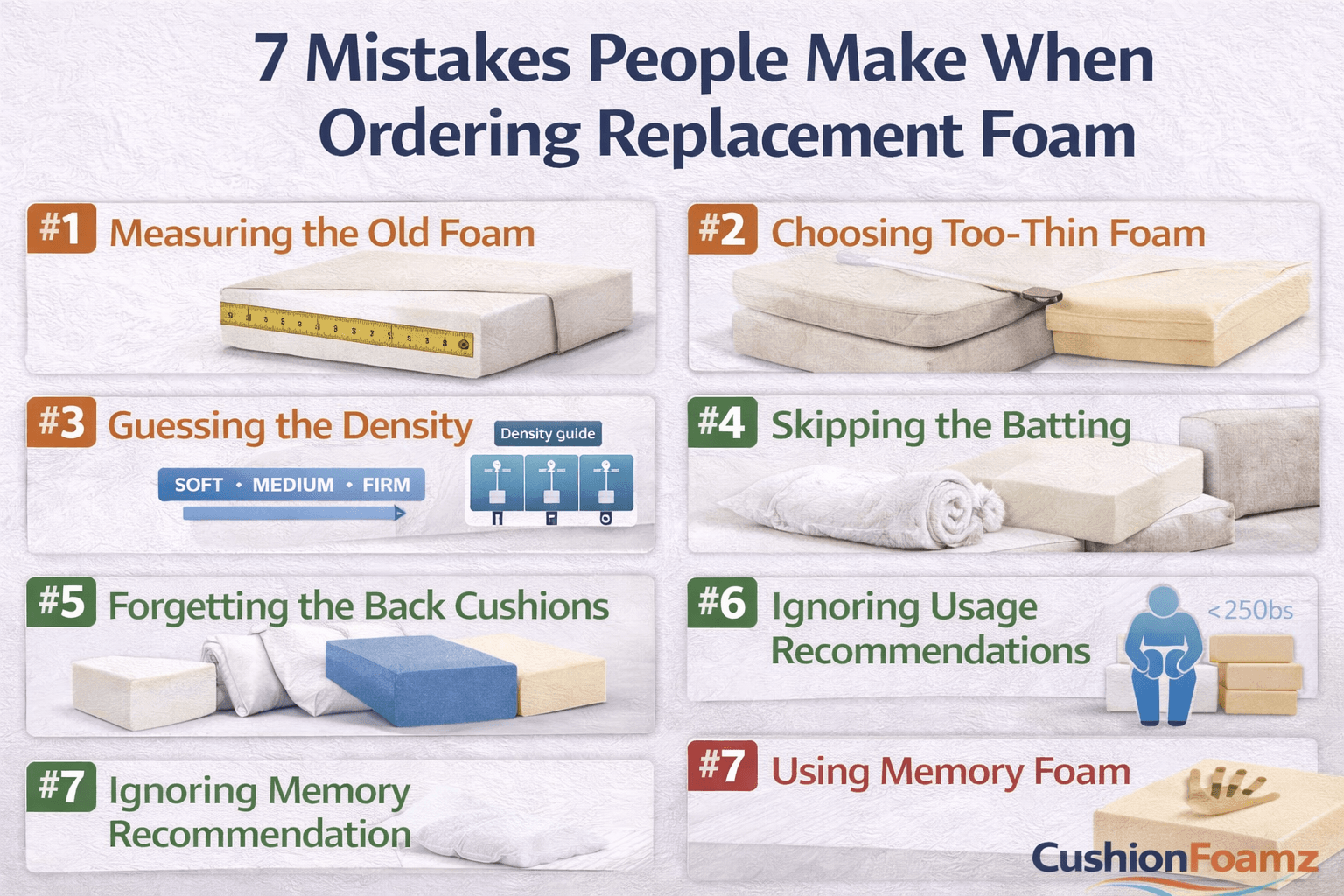
7 Mistakes People Make When Ordering Replacement Foam (And How to Avoid Them)
Foam replacement is one of the simplest home improvement projects you can do — measure, order, insert, done. But there are specific mistakes that trip up first-time buyers and lead to foam that does not fit, does not feel right, or does not last. We have seen thousands of orders and these same seven errors account for the vast majority of customer frustrations.
The good news: every mistake on this list is easily avoidable once you know what to watch for. Read this before you place your order and you will join the 95+ percent of customers who get it right the first time.
Mistake #1: Measuring the Old Foam Instead of the Cushion Cover
The mistake: Pulling out the old foam insert, measuring its length, width, and thickness, and ordering replacement foam to match those dimensions.
Why it fails: Old foam has been compressed, distorted, and degraded for years. A cushion that was originally 24 × 24 × 5 inches might measure 22 × 23 × 3.5 inches by the time you replace it. If you order foam based on these degraded dimensions, it will be significantly undersized for the cover. The cushion will look baggy, feel unsupported, and not fill out the cover properly.
The fix: Always measure the cushion cover from inside seam to inside seam — never the old foam. The cover retains its original dimensions because fabric does not compress like foam does. The cover is your blueprint; the foam needs to match it.
For the complete measuring methodology, including special shapes like T-cushions and L-cushions, see our detailed measuring guide.
Mistake #2: Choosing Foam That Is Too Thin
The mistake: Ordering foam at the same thickness as the compressed old foam, or choosing a thinner-than-original thickness to save money.
Why it fails: Foam thickness directly determines whether you bottom out (feel the sofa frame through the cushion). Four inches is the minimum for most sofa seat cushions. Three inches works for benches and chairs where sessions are shorter. Going below these thresholds — even by an inch — dramatically reduces comfort and support, especially for average-to-larger body types.
The fix: Measure the cushion cover thickness from seam to seam (not the old foam's current thickness). Order foam at that exact measurement. If you are unsure about the original thickness because the cover has stretched, err toward the thicker end: five inches for sofa seats, four inches for benches, three inches for dining chairs. For people over 200 pounds, add an inch to these minimums. See our foam guide for heavier individuals for weight-specific recommendations.
Mistake #3: Ignoring Foam Density (Buying on Price Alone)
The mistake: Shopping for the cheapest foam available without considering density, then being surprised when it goes flat in six to twelve months.
Why it fails: Foam density (measured in lb/ft³) is the single strongest predictor of how long the foam will last and how well it performs. Budget foam at 1.5 lb/ft³ costs 40 to 50 percent less per cubic inch than professional-grade 2.8 lb foam — but it lasts one-third as long. The math works against cheap foam every time.
| Foam Density | Approximate Cost per Cushion | Lifespan | Cost per Year |
|---|---|---|---|
| 1.5 lb/ft³ (budget) | $12–$30 | 1–3 years | $10–$30 |
| 1.8 lb/ft³ (standard) | $15–$40 | 3–5 years | $5–$13 |
| 2.8 lb/ft³ (professional) | $20–$70 | 8–15 years | $1.50–$9 |
The fix: Buy on cost-per-year, not cost-per-unit. Our 2.8 lb HR foam at $0.07 per cubic inch is the best value over the life of the foam. For the full density breakdown, see our foam density and firmness guide.
Mistake #4: Using Indoor Foam Outdoors
The mistake: Putting standard polyurethane foam in patio furniture, boat cushions, or any outdoor application because it is cheaper than Dry Fast foam.
Why it fails: Standard indoor foam absorbs water. Outdoors, it encounters rain, dew, humidity, pool splashes, and morning condensation. The foam becomes a waterlogged sponge within weeks, develops mold in the cell structure, becomes impossibly heavy, and breaks down chemically from sustained moisture exposure. This damage is irreversible — once mold colonizes the foam, the cushion must be discarded.
The fix: Any cushion that might get wet needs Dry Fast outdoor foam. The higher price ($0.14 vs. $0.07 per cubic inch) is an investment in not having to replace your cushions every season. Dry Fast foam drains water instantly and resists mold — it is the only appropriate foam for outdoor, marine, and wet-environment applications. See our indoor vs. outdoor foam comparison for a complete breakdown of when to use each type.
Mistake #5: Forgetting to Adjust Sizing When Using Dacron Batting
The mistake: Ordering foam with the standard half-inch sizing buffer AND adding Dacron batting wrap, resulting in a cushion that is too tight to zip into the cover.
Why it fails: The half-inch buffer (adding half an inch to width and depth) is designed to fill the cover snugly when using bare foam. Dacron batting adds approximately a quarter to half inch on each wrapped surface. When you combine both, the total insert size exceeds the cover dimensions by an inch or more — making the cushion impossible to zip closed or creating an overstuffed, distorted appearance.
The fix:
- Foam without Dacron: Order at cover dimensions + ½ inch width and depth.
- Foam with Dacron: Order at exact cover dimensions (no buffer). The batting provides the fill.
This is one of the most common sizing errors and the easiest to prevent. For the complete guide to Dacron batting — when to use it and how to adjust dimensions, see our dedicated batting guide.
Mistake #6: Replacing Only Some Cushions
The mistake: Replacing the one or two most worn seat cushions while leaving the others with the original old foam.
Why it fails: New foam and old foam have dramatically different firmness and height. Sitting on the sofa, you will feel a distinct step between the new cushion (firm and full) and the adjacent old cushion (soft and compressed). Visually, the new cushion sits higher and looks plumper while the old cushion sags beside it. The contrast actually makes the old cushions look worse than if all cushions had been equally worn.
The fix: Replace all seat cushions simultaneously. This ensures uniform height, firmness, and appearance across the entire seating surface. Back cushions can be phased in later if budget is a concern — the firmness difference in back cushions is less noticeable than in seats.
If budget absolutely requires replacing one cushion at a time, start with the worst cushion and plan to replace the remaining cushions within a few weeks. Do not let the mixed state persist long-term.
Mistake #7: Choosing the Wrong Foam Type for the Application
The mistake: Using soft foam for a daily-use sofa seat (it will compress quickly), firm foam for a reading nook (it will feel like a park bench), or memory foam for a sofa cushion (it will bottom out, retain heat, and develop permanent body impressions).
Why it fails: Different applications need different foam characteristics. A one-size-fits-all approach leads to mismatched comfort and premature wear.
The fix: Here is the quick reference:
| Application | Recommended Foam | Firmness |
|---|---|---|
| Sofa seat cushions | 2.8 lb HR indoor | Medium-firm |
| Sofa back cushions | 2.8 lb HR indoor | Medium to medium-firm |
| Dining chairs (1–2 in) | 2.8 lb HR indoor | Medium-firm to firm |
| Window seats / benches | 2.8 lb HR indoor | Medium-firm |
| Patio furniture | Dry Fast outdoor | Medium |
| Boat cushions | Dry Fast outdoor | Medium to firm |
| RV interior | 2.8 lb HR indoor | Medium-firm |
| Pet beds | 2.8 lb HR indoor (or Dry Fast for outdoor) | Medium-firm |
For seating cushions specifically, memory foam is almost never the right choice — see our detailed comparison for the full reasoning. For the technical explanation of how density and firmness work together, our density guide is the definitive reference.
Bonus: The Most Common "Non-Mistake" Worry
"My new foam is too firm — did I order wrong?"
This is not a mistake. New foam — especially high-density HR foam — feels firmer than what you are used to because you have been sitting on degraded, compressed foam for years. Your perception of "normal" firmness has drifted as the old foam slowly collapsed.
New medium-firm 2.8 lb HR foam requires a break-in period of one to two weeks. During this time, the cell structure loosens slightly from daily use and the foam reaches its optimal comfort level. After break-in, most customers describe the feel as perfectly supportive — firm enough to not bottom out, soft enough to be comfortable for hours.
If the foam still feels too firm after two weeks of daily use, contact us and we can discuss options. But in our experience, the vast majority of "too firm" concerns resolve naturally during the break-in period.
Pre-Order Checklist
Before you place your order, verify these seven items:
- ✅ Measured the cover from seam to seam (not the old foam)
- ✅ Chose at least 4-inch thickness for sofa seats (5+ for people over 200 lbs)
- ✅ Selected 2.8 lb HR foam (not budget 1.5 lb foam)
- ✅ Selected indoor foam for indoor use, outdoor Dry Fast for outdoor/marine
- ✅ Adjusted sizing for Dacron batting (exact cover dims if using batting, +½ inch if bare foam)
- ✅ Replacing ALL seat cushions in the set (not just the worst one)
- ✅ Matched foam type and firmness to the application
Check all seven? You are ready to order.
Open the CushionFoamz configurator →
For the complete replacement process from start to finish, see our step-by-step guide. To see what the results look like, browse our customer before and after transformations.