Leather Sofa Cushion Foam Replacement: Tips for Working with Leather Covers
Leather sofas hold a special place in furniture ownership. They age beautifully, develop character over time, and often outlast fabric sofas by decades. A quality leather sofa is furniture you pass down to the next generation — or at least furniture you expect to keep for fifteen to twenty years.
The leather itself will hold up. The foam inside will not. And when leather sofa cushions start sagging, the visual effect is particularly stark. Wrinkled, deflated leather cushions look worse than their fabric counterparts because leather does not drape softly over compressed foam — it creases, buckles, and develops deep fold lines that make the entire sofa look neglected.
The good news: replacing foam in a leather sofa is not only possible, it is often easier than replacing foam in fabric sofas. Leather is more durable, more forgiving of the insertion process, and responds beautifully to fresh, properly sized foam. This guide covers everything specific to leather cushion foam replacement — from accessing the foam without scratching the leather to getting that signature full, taut look that makes leather furniture so appealing.
Why Leather Sofa Foam Fails (And Why It Looks Worse Than Fabric)
Leather sofa foam fails for the same reason all furniture foam fails: the cellular structure of the polyurethane degrades under repeated compression, losing height, density, and the ability to return to its original shape. The timeline depends on the foam quality the manufacturer used — typically 1.8 to 2.2 lb/ft³ in most leather sofas, giving you four to seven years before noticeable degradation. For the complete lifespan breakdown, see our guide on how long cushion foam lasts.
But degraded foam looks worse in leather for specific reasons:
Leather does not stretch to fill gaps. When foam compresses inside a fabric cushion cover, the fabric drapes loosely over the smaller foam and the visual effect is a soft, saggy pillow. When foam compresses inside a leather cover, the leather holds its shape more rigidly and creates harsh creases, wrinkles, and buckling that look structural rather than just worn. The cushion appears collapsed rather than merely tired.
Leather shows every contour change. Leather telegraphs the shape of whatever is beneath it with high fidelity. Full, firm foam shows as a smooth, taut surface. Compressed, misshapen foam shows as lumps, dips, and asymmetric bulges.
Leather furniture tends to be expensive. The contrast between a $3,000 to $8,000 sofa and the worn-out appearance of its cushions creates a jarring disconnect. People expect leather furniture to look sharp, and sagging cushions undermine the entire piece.
The fix is identical to any sofa: replace the foam. But leather has a few unique considerations.
Accessing the Foam in Leather Cushions
Zippered Leather Cushions
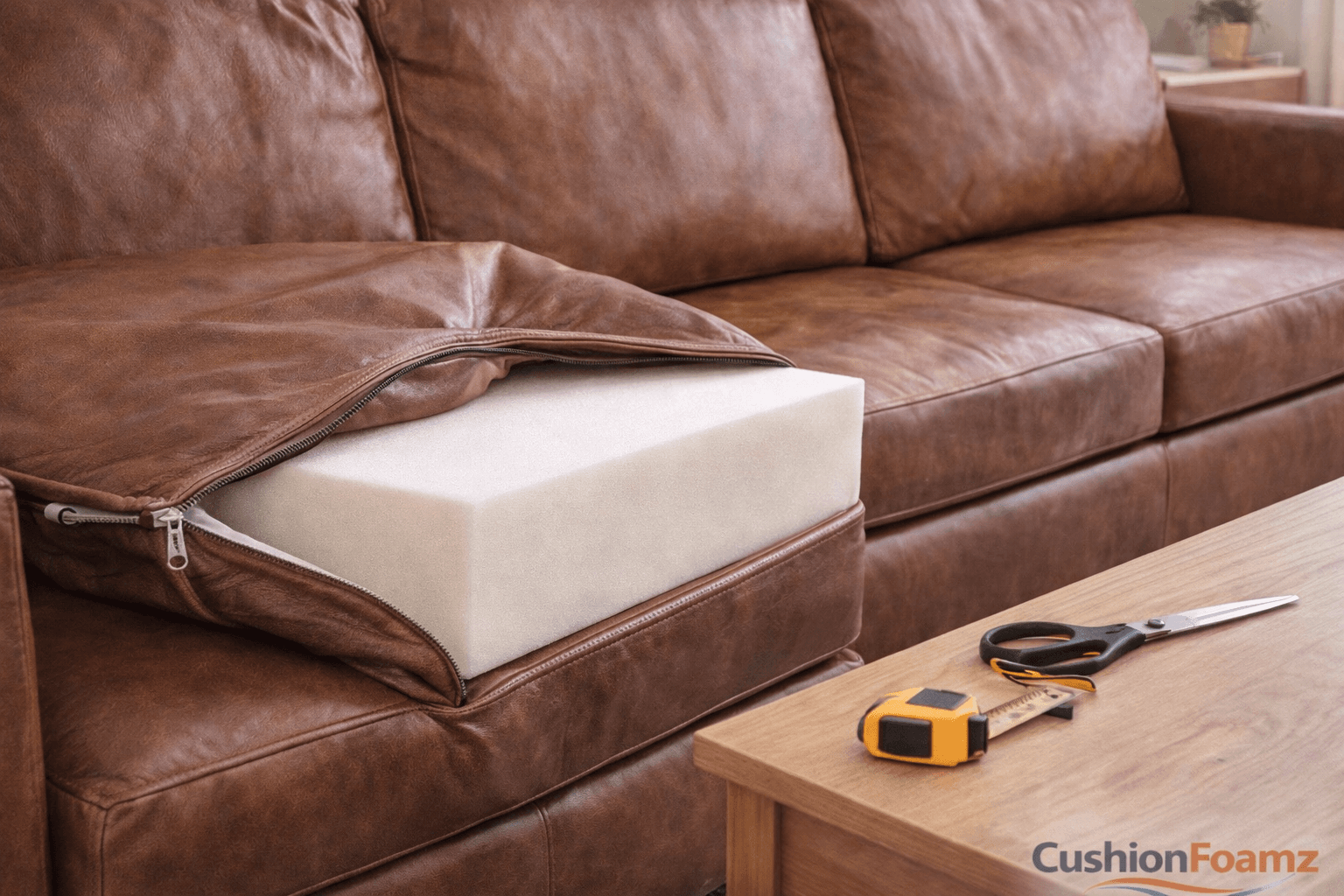
Most leather sofas manufactured in the last twenty years have zippered cushion covers, typically along the back edge or the bottom edge of the cushion. The zipper is often concealed in a welted seam for aesthetics.
To access: open the zipper fully and peel back the leather cover. The foam (often wrapped in Dacron batting or a muslin liner) slides out. This is no different from a fabric sofa — the process is straightforward.
Leather-specific tip: Leather zippers can be stiff from years of non-use. If the zipper resists, apply a small amount of zipper lubricant or rub a candle or bar of soap along the teeth to reduce friction. Never force a leather zipper — a broken zipper on leather is significantly more expensive to repair than on fabric.
Non-Zippered Leather Cushions
Some leather sofas, particularly older or higher-end models, have cushion covers that are sewn closed with no zipper access. The leather is stitched together along the bottom or back seam using a technique that is invisible from the outside.
Options for accessing foam in sewn-shut leather cushions:
-
Have an upholsterer open and re-sew the seam. This is the safest approach. A professional leather upholsterer can open a seam cleanly, allow you to swap the foam, and re-sew it invisibly. Cost: $25 to $50 per cushion.
-
Open the seam yourself. Use a seam ripper to carefully open the stitching along the bottom or back seam — whichever is least visible. Swap the foam, then re-sew using a curved upholstery needle and heavy-duty thread in a matching color. This is more advanced than the same operation on fabric because leather requires a leather needle and does not forgive stitch holes (every hole is permanent).
Our recommendation: Unless you have upholstery experience, pay a professional to handle non-zippered leather cushions. The cost is modest and eliminates the risk of visible damage.
Attached Leather Cushions
Some leather sofas have cushions that are upholstered directly to the frame with no removable cover at all. This requires professional upholstery work — the leather must be detached from the frame, the foam replaced, and the leather re-attached and re-stretched. This is beyond a DIY project but is routine work for any leather upholstery shop. Expect $75 to $150 per cushion for professional foam replacement in attached leather cushions.
Choosing Foam for Leather Sofas
Density: Go High
Leather sofa cushions benefit enormously from high-density foam because leather shows every imperfection in the foam beneath it. Low-density foam that develops body impressions or uneven compression will telegraph those irregularities through the leather surface as visible dips and bumps.
Our 2.8 lb/ft³ HR foam resists body impressions far longer than lower-density alternatives, keeping the leather surface smooth and uniform for years. This is especially important for leather because replacing foam in leather is slightly more involved than in fabric — you want to minimize how often you need to do it.
Firmness: Medium-Firm or Firm
Leather sofas generally look and feel best with medium-firm to firm foam. Here is why:
Visual appearance: Firmer foam fills the leather cover more completely, creating the taut, smooth surface that defines quality leather furniture. Softer foam allows the leather to wrinkle and sag even when new, because leather does not drape as readily as fabric.
Seated feel: Leather surfaces have less friction than fabric, which means you slide slightly on leather. Firmer foam provides a more stable seating platform that counteracts the tendency to slide forward.
Weight support: Leather sofas tend to be used as primary living room seating, meaning daily heavy use. Firmer foam holds up better under this usage pattern. For specific recommendations based on body weight, see our foam guide for heavier individuals.
Dacron Batting: Highly Recommended for Leather
Dacron batting serves an especially important function with leather cushions:
-
Prevents foam grip. Bare foam can grip the interior surface of leather, causing the cover to wrinkle and pull unevenly when you sit down or stand up. Dacron creates a smooth barrier that allows the leather to move independently of the foam.
-
Rounds the edges. Leather telegraphs the sharp edges of bare foam as visible lines through the cover. Dacron softens these edges into gentle curves that look professionally upholstered.
-
Eases insertion. Sliding foam into a leather cover is more difficult than fabric because leather has higher friction. Dacron-wrapped foam glides into the cover more smoothly.
For leather cushions, we recommend a full book wrap at minimum, or a full wrap (all sides) for the most polished result.
The Insertion Process for Leather Covers
Getting foam into a leather cushion cover requires more care than fabric because leather is less flexible and the cover opening is often narrower.
The Plastic Bag Method (Essential for Leather)
This technique is virtually mandatory for leather cushions:
- Wrap the foam (with Dacron if using) in a thin plastic garbage bag.
- Compress and fold the bagged foam to fit through the cover opening.
- Slide the bagged foam into the cover, working it into the far corners first.
- Once the foam is positioned correctly inside the cover, pull the plastic bag out through the zipper opening.
The plastic eliminates all friction between the foam/Dacron and the leather interior. Without it, you will fight the foam every inch and risk stretching or tearing the leather cover at the zipper opening.
Working the Corners
Leather covers hold their shape more rigidly than fabric, which means the corners of the cover can be stiff and resistant to accepting the foam. After inserting the foam, work each corner individually — push the foam firmly into each corner from the outside of the cover, pressing the leather against the foam to seat it properly.
Final Smoothing
Once the foam is in and the zipper is closed, stand the cushion upright and smooth the leather surface from center to edges with your hands. This redistributes any bunching in the leather and settles the foam into its final position. Place the cushion on the sofa and sit on it briefly, then stand and smooth again. After two or three cycles, the leather will be settled perfectly over the new foam.
Down-Blend Leather Cushion Replacement
Many premium leather sofas (Restoration Hardware, Arhaus, Ethan Allen, some Pottery Barn lines) use a down-blend construction: a foam core wrapped in a down or down-alternative envelope, all inside the leather cover. This creates the signature soft, pillowy feel that these brands are known for.
When replacing foam in a down-blend leather cushion:
- Unzip the leather cover and remove the entire insert (foam core inside the down envelope).
- Open the down envelope (it typically has a muslin cover with a zipper or sewn closure).
- Remove the old foam core from the envelope. This is the piece you are replacing.
- Measure the down envelope's interior — not the old foam, which has compressed. The envelope dimensions are your foam order dimensions.
- Insert the new foam into the down envelope.
- Place the reassembled insert (new foam inside down envelope) back into the leather cover.
The down envelope reuses perfectly — it does not degrade like foam does. If the down has shifted or clumped, redistribute it evenly before re-inserting into the leather cover.
For more on brand-specific cushion construction, see our replacement foam guide for popular sofas.
Measuring Leather Cushion Covers
The standard measuring approach applies: measure the cover from inside seam to inside seam for width, depth, and thickness. See our complete measuring guide for the detailed process.
Leather-specific measuring notes:
- Leather covers are typically manufactured to tighter tolerances than fabric covers, so measurements tend to be precise.
- Add the standard half-inch buffer to width and depth for bare foam. If using Dacron, order at exact cover dimensions (the batting provides the buffer).
- If the leather cover has stretched over time (possible with softer leathers on older sofas), measure the cover when it is lying flat and naturally relaxed — not stretched or compressed.
Caring for Leather After Foam Replacement
New foam restores the cushion to its proper fullness, which may stretch the leather slightly from its compressed state. This is normal and beneficial — the leather returns to its intended dimensions. Over the first week, the leather will settle around the new foam.
Post-replacement care:
- Condition the leather with a quality leather conditioner after installation. The new foam fills the cover more completely, and conditioned leather is more supple and accommodates the fuller foam more easily.
- Avoid sitting exclusively in one spot for the first few weeks. Distribute your seating to allow the leather and foam to break in evenly.
- Continue regular leather maintenance (conditioning every three to six months) to keep the leather supple and prevent cracking.
Frequently Asked Questions
Will the foam replacement process scratch my leather?
Not if you use the plastic bag insertion method. Direct contact between foam and leather does not cause scratching — the risk comes from forcing foam through a tight opening and catching the leather on the zipper or the folded foam edge. The plastic bag eliminates this friction entirely.
Can I use any foam in a leather sofa or does leather require special foam?
Leather does not require special foam. Our standard 2.8 lb HR foam in medium-firm is ideal for leather sofas. The key difference is in the finishing — Dacron batting is more important for leather than fabric, and the insertion technique requires more care.
My leather cushion covers are cracked and peeling. Should I still replace the foam?
If the leather itself is significantly deteriorated (deep cracks, peeling, flaking), the covers may not survive another foam insertion. In this case, consider having the covers replaced by a leather upholsterer simultaneously with the foam replacement. If the cracking is cosmetic and the leather is still structurally intact, foam replacement is still worthwhile — the fuller foam may actually reduce further cracking by supporting the leather more evenly.
Is bonded leather treated differently than full-grain leather?
Bonded leather (a composite of leather fibers and polyurethane) is more fragile than full-grain leather and is prone to peeling and flaking, especially on older sofas. Handle bonded leather covers with extra care during foam replacement. If the bonded leather is already peeling, the cover may not survive removal and re-insertion of foam. Full-grain and top-grain leather are durable enough to handle the process without issue.
The Bottom Line
Leather sofas are among the best candidates for foam replacement because the leather covers last far longer than the foam inside them. A leather sofa with fresh, high-density foam looks and feels like a $5,000 piece of furniture — because it is. The frame is built for decades. The leather ages gracefully. Only the foam needed an upgrade.
For $80 to $300 in professional-grade foam, you restore a leather sofa that would cost thousands to replace. The investment is one of the highest-return home maintenance projects available.
Ready to restore your leather sofa? Build your custom foam order →
For the full replacement process, see our step-by-step couch cushion guide, or explore our custom sofa cushion page for complete foam specifications.