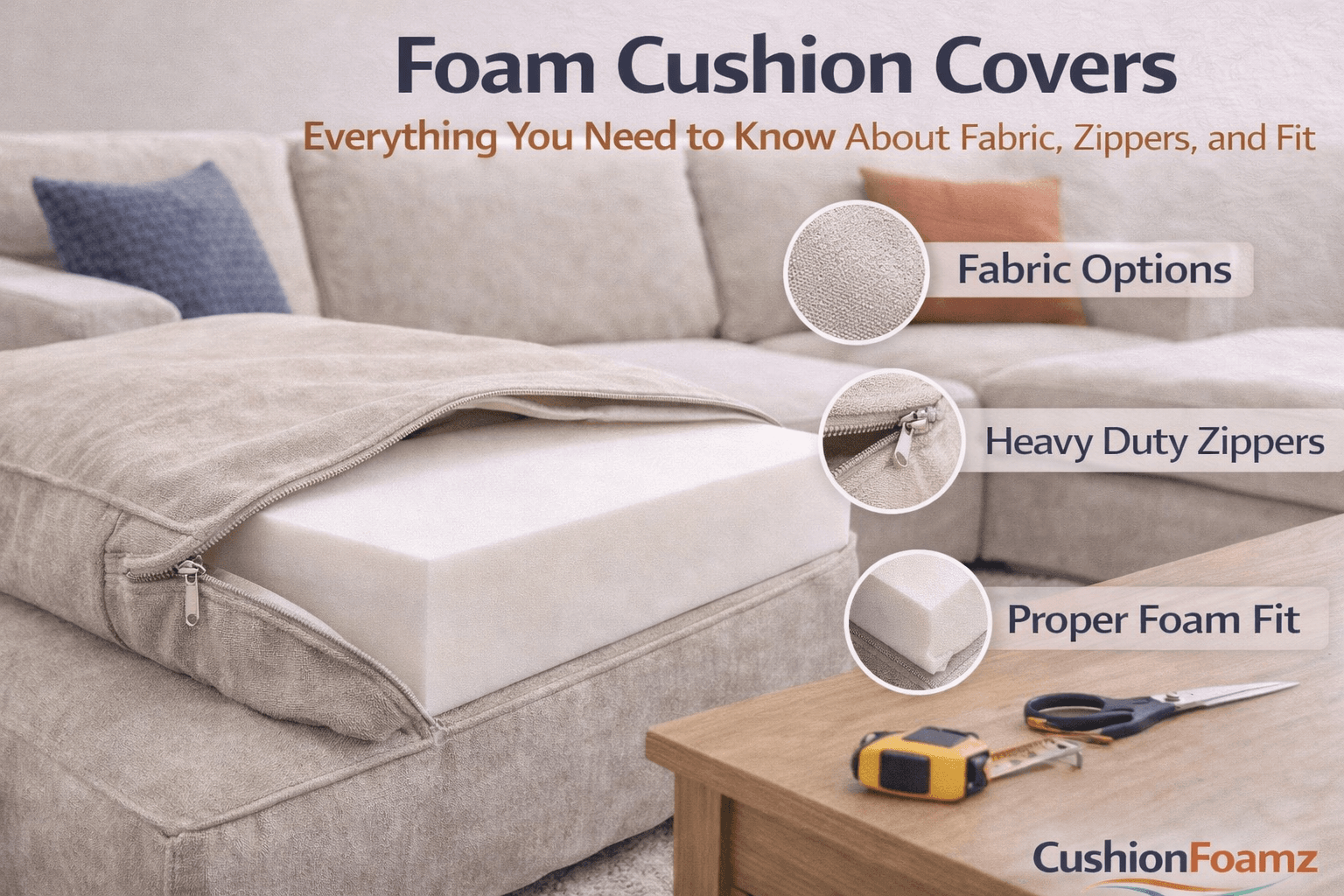
Foam Cushion Covers: Everything You Need to Know About Fabric, Zippers, and Fit
You have decided to replace the foam in your cushions — or you already have brand-new custom-cut foam waiting to be installed. The next question: what about the covers?
For many projects, your existing cushion covers are perfectly fine. Fabric lasts far longer than foam, so the covers on a sofa with five-year-old dead foam are usually in excellent condition and ready to accept new inserts. But sometimes the covers are stained, torn, faded, or just due for an update. And for new builds — window seats, headboards, benches — you need covers from scratch.
This guide walks through everything related to the exterior of your foam cushion: when to reuse existing covers versus replacing them, how to choose fabric for new covers, the construction details that affect fit and longevity, and where to source covers at every price point.
When to Reuse Your Existing Covers
In the majority of foam replacement projects, the answer is simple: keep your covers. Fabric degrades far more slowly than foam, especially when protected from direct sunlight. If your covers pass these three tests, they are ready for new foam:
Structural integrity test: Are the seams intact? Is the zipper functional? Can the fabric handle the stress of inserting slightly oversized foam without tearing? Pull gently on the seams — if they hold without separating, the cover is structurally sound.
Appearance test: Are there stains that will not come out? Is the fabric faded beyond acceptability? Are there worn-through spots, pilling, or snags? Minor imperfections often become less visible once the cover is filled with plump new foam — a full cushion looks significantly better than a saggy one even with the same fabric.
Fit test: Has the cover stretched significantly from years of accommodating compressed foam? Measure it and compare to the original dimensions. Minor stretching (up to an inch) is normal and the new foam will fill the extra space. Significant stretching (two or more inches) may result in a loose fit even with oversized foam.
If your covers pass all three tests, skip ahead to our complete foam replacement guide and install your new foam directly into the existing covers. This saves the cost and effort of new covers entirely.
When to Replace Your Covers
New covers make sense when:
- The fabric is torn, worn through, or structurally compromised at the seams
- Stains are permanent and cosmetically unacceptable
- You want to update the style, color, or pattern of your furniture
- The original covers lack zippers and you want easy-access covers for future foam changes
- You are building a new cushion (window seat, bench, headboard) that has no existing cover
Choosing Fabric for Cushion Covers
Indoor Upholstery Fabrics
For sofa, chair, and indoor bench cushions, choose fabric rated for upholstery use — not drapery or apparel fabric. Upholstery fabric is woven tighter, rated for abrasion resistance (measured in double rubs), and designed to withstand the stress of daily sitting.
Cotton and cotton blends: Comfortable, breathable, available in endless patterns and colors. Moderate durability (15,000 to 30,000 double rubs). Best for light to moderate-use furniture.
Linen and linen blends: Natural, textured, visually elegant. Similar durability to cotton. Prone to wrinkling, which gives a relaxed aesthetic some people love and others find untidy.
Polyester and performance fabrics: Highly durable (50,000+ double rubs), stain-resistant, fade-resistant, and easy to clean. Brands like Crypton and Revolution offer performance upholstery fabrics that handle spills, kids, and pets with minimal maintenance. Excellent for family-use furniture.
Velvet: Luxurious feel and appearance. Modern velvet (typically polyester-based) is surprisingly durable and stain-resistant. Adds a premium look to any cushion project.
Microfiber: Soft, stain-resistant, affordable, and extremely durable. A practical choice for high-traffic furniture.
Leather and faux leather: Premium durability and distinctive appearance. For leather cushion foam replacement, see our dedicated leather sofa guide.
Outdoor Fabrics
For patio, marine, and outdoor cushions using Dry Fast foam, the cover fabric must be engineered for weather exposure:
Sunbrella: The industry standard for outdoor upholstery. Solution-dyed acrylic that resists fading, mold, and staining. Breathable enough to allow moisture movement through the cushion system. Available in hundreds of colors and patterns. This is our top recommendation for outdoor cushion covers.
Olefin: Budget-friendly outdoor fabric with good fade and moisture resistance. Less color variety than Sunbrella but functional and affordable.
Marine vinyl: Waterproof and extremely durable. Common on boat cushions. Can feel hot and sticky in direct sun. Best when paired with drainage grommets on the bottom panel so water can exit the cover.
For outdoor foam that performs best, the cover should allow water to move through or exit via drainage — trapping water inside the cover defeats the purpose of Dry Fast foam's drainage properties.
Cover Construction: What Makes a Good Cushion Cover
The Box Cushion (Standard Sofa Cover)
Most sofa and chair cushions use a "box" construction: a top panel, a bottom panel, and a side panel (called the "boxing strip" or "border") that connects the two. The boxing strip's height determines the cushion thickness. This construction creates the familiar rectangular box shape of standard sofa cushions.
Quality indicators in box cushion construction:
- Double-stitched seams for strength
- Welting or piping along the seam lines for a finished appearance and added seam strength
- Full-length zipper on the back or bottom panel for easy foam access
- Correct boxing strip height matching your foam thickness plus batting if applicable
Zippers: The Most Important Feature
A zipper transforms a cushion cover from a permanent fixture into a removable, washable, replaceable system. Insist on zippered covers for any cushion where you might need to access the foam in the future — which is all of them.
Zipper placement: The back edge (most common on sofas) or the bottom panel (common on benches and chairs). Back-edge zippers are concealed when the cushion is placed against the sofa back. Bottom zippers are hidden by the cushion's weight.
Zipper type: YKK or equivalent quality metal or nylon zippers. Cheap plastic zippers fail under the stress of inserting snug foam and are the most common point of failure in budget covers.
Welting and Piping
Welting (also called piping) is the cord-covered trim that runs along the seams of a cushion cover. It serves both aesthetic and structural purposes:
- Visually: Creates clean, defined edges that give the cushion a professional, finished look
- Structurally: Reinforces the seam and distributes stress during foam insertion
Self-welt uses the same fabric as the cover. Contrast welt uses a different color for a designer accent. Both are signs of quality construction.
How to Measure for New Covers
If you are ordering custom covers, you need precise measurements:
- Width: The finished cover's interior width should match your foam width (no buffer — the foam provides the fill).
- Depth: Same as width — match the foam's depth exactly.
- Thickness (boxing strip height): Match your foam thickness. If using Dacron batting, add half an inch to the boxing strip height to accommodate the batting's volume.
- Shape: Specify rectangle, T-shape, L-shape, bullnose, or custom shape. Provide a template for non-standard shapes.
For the foundational measuring methodology, reference our cushion measuring guide. The same principles of precision apply to covers as to foam.
Where to Get Cushion Covers
Option 1: Reuse Existing (Free)
The best option when covers are in good condition. Simply clean them (machine wash if removable, spot clean if not) and insert new foam.
Option 2: Manufacturer Replacements ($50–$200 per cushion)
Many sofa brands sell replacement covers for current and recent models. Contact the manufacturer's customer service with your model name/number. This gives you an exact-match replacement but at premium prices with limited fabric options.
Option 3: Custom Cover Makers ($40–$150 per cushion)
Online custom cushion cover services let you specify dimensions, fabric, zipper placement, and welt style. You provide measurements and they sew to order. Search for "custom cushion covers" or "replacement sofa cushion covers" to find multiple options. Lead times are typically two to four weeks.
Option 4: Local Seamstress or Upholsterer ($30–$80 per cushion)
A local sewing professional can make covers from your choice of fabric. This gives you maximum control over fabric selection and construction quality. Bring your foam (or foam dimensions) and a fabric swatch to discuss the project. Many local upholsterers will also source fabric for you from wholesale suppliers.
Option 5: DIY Sewing ($10–$30 per cushion in materials)
If you sew, a basic box cushion cover is a straightforward project — three panels (top, bottom, boxing strip), welting optional, and a zipper. Fabric cost runs $10 to $30 per cushion depending on the material. Hundreds of tutorials exist online for "how to sew a box cushion cover."
Option 6: No-Sew Options ($5–$15)
For casual applications (floor cushions, pet beds, temporary bench seats), a fitted sheet, pillowcase, or fabric wrap works without any sewing. These are not permanent solutions but serve the purpose for informal use. We cover several no-sew approaches in our DIY foam projects guide.
Covers and Foam Together: Getting the Fit Right
The relationship between cover dimensions and foam dimensions determines how the finished cushion looks and feels:
Foam slightly larger than cover (½ inch on width and depth): Creates a snug, professional look. The foam compresses slightly when inserted, filling the cover completely with no gaps or wrinkles. This is the standard approach when using bare foam without batting.
Foam at exact cover dimensions with Dacron batting: The batting adds the half-inch buffer. Creates the same snug fit with the added benefit of rounded edges and softer surface feel.
Foam smaller than cover: Results in a loose, baggy appearance. The cover does not fill out properly and wrinkles form on the surface. This is almost always a measuring error. See our guide on common foam ordering mistakes to avoid this.
Foam significantly larger than cover: The cover cannot zip closed, or the cushion looks overstuffed and distorted. Back off on foam dimensions by a quarter to half inch if you cannot zip the cover after inserting foam.
Frequently Asked Questions
Can I wash my cushion covers in the washing machine?
If the covers have a care label that says machine-washable, yes. Most cotton, polyester, and performance fabric covers handle machine washing on a gentle cycle in cold water. Line dry or tumble dry on low. Do not machine wash leather, velvet, or silk covers — spot clean only. Always wash covers before inserting new foam to start fresh.
Should I get covers with ties?
Ties are useful for bench cushions, window seats, and dining chairs where the cushion sits on a smooth surface and tends to slide. Sofa cushions sit in a recessed frame and generally do not need ties. For window seat projects, ties or Velcro are recommended to keep the cushion in position.
What fabric weight should I look for?
Medium-weight upholstery fabric (7 to 12 oz per linear yard) is the sweet spot for cushion covers. Lighter fabrics lack durability for daily sitting. Heavier fabrics are difficult to sew and feel stiff. Most upholstery fabric at fabric stores is already in the appropriate weight range.
Can I reupholster my entire sofa if I am already replacing the foam?
If your sofa has removable cushion covers (zippered or slip-stitched), replacing the covers is the extent of the "upholstery" work needed. If you want to change the fabric on the sofa frame itself (the arms, back, and skirt), that is a full reupholstery project — significantly more complex and expensive. For most people, new foam inside new or existing cushion covers provides a dramatic refresh without the cost and complexity of full reupholstering. Our cost guide compares the economics of each approach.
The Bottom Line
In most foam replacement projects, your existing covers are fine — clean them, insert new foam, and you are done. When covers do need replacing, the options range from manufacturer replacements to custom makers to DIY sewing, with costs from $10 to $200 per cushion depending on your approach.
The key is matching the cover dimensions precisely to your foam dimensions. Measure accurately, account for Dacron batting if using it, and choose a fabric rated for your application (upholstery-weight for indoor, Sunbrella for outdoor). The cover is the finishing touch that makes your new foam look as good as it feels.
Ready to order the foam for inside those covers? Build your custom cushion →
Explore our custom sofa cushion page for indoor foam options, or visit our How It Works page to see the complete process from measuring to delivery.