Patio Furniture Foam Replacement: Restore Your Outdoor Cushions for Spring
Spring arrives and you head to the patio with your morning coffee, only to discover that your outdoor cushions spent the winter becoming waterlogged sponges with a faint smell of mold. You flip them over. Worse underneath. You try drying them in the sun for a day. Still damp inside. You consider tossing the entire patio set and starting over — furniture, cushions, and all — because the cushions have become a recurring annual headache.
Stop. Your patio furniture is almost certainly fine. The foam is the problem. And unlike your indoor sofa where foam replacement is an upgrade, outdoor cushion foam replacement is often a complete transformation — because the factory foam was the wrong type of foam in the first place.
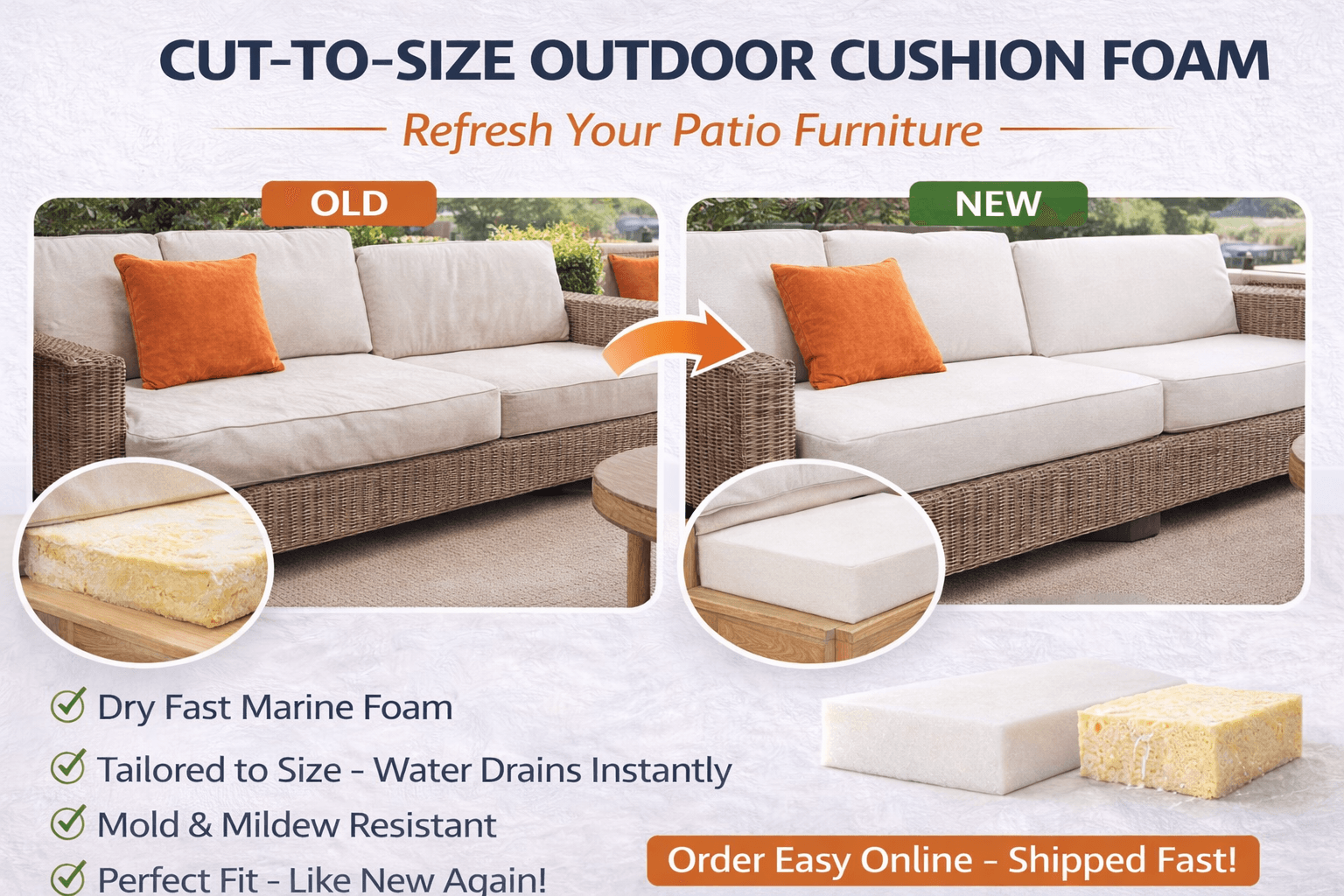
Most patio furniture ships with standard polyurethane foam that has no business being outdoors. When you replace it with Dry Fast reticulated foam — the only foam type engineered for wet environments — you eliminate the waterlogging, mold, and odor problems permanently. This guide walks you through the entire process.
Why Your Patio Cushion Foam Failed
The foam inside most factory patio cushions is conventional polyurethane — the same type used in indoor sofas. Some manufacturers wrap it in a thin plastic liner or use a "water-resistant" cover and call it outdoor-ready. But the foam itself is not water-resistant in any meaningful way.
Conventional foam has a closed or semi-open cell structure that traps water. One rainstorm. One morning of heavy dew. One forgotten sprinkler session. The foam absorbs water and becomes a reservoir that takes days to dry — if it ever fully dries at all. In climates with regular rain or high humidity, the foam never reaches a fully dry state between moisture events.
The consequences are predictable and progressive: the foam stays perpetually damp inside. Mold and mildew colonize the moist interior. The foam begins to break down chemically from sustained water exposure. The cushions get heavier, smellier, and less supportive. By year two, most patio cushion owners are either throwing out cushions annually or giving up on cushioned outdoor seating altogether.
For a detailed technical explanation of why standard foam fails outdoors and how Dry Fast foam differs, see our indoor vs. outdoor foam comparison.
What Dry Fast Foam Does Differently
Dry Fast reticulated foam has its cell walls removed during manufacturing, leaving a skeletal web structure that is approximately 97 percent open air. Water cannot be trapped because there are no cell walls to contain it. Rain hits the cushion and falls straight through. Dew evaporates in minutes instead of days.
Additionally, Dry Fast foam includes built-in antimicrobial properties that prevent mold and mildew colonization even in perpetually humid conditions. UV resistance means the foam does not degrade from sun exposure. The material performs across the full temperature range, from freezing winter storage to blistering summer heat.
This is the same foam used in marine and boat cushion applications where water exposure is constant and unrelenting. If it handles ocean spray, it can handle your patio.
How to Replace Your Patio Cushion Foam
Step 1: Assess Your Current Cushions
Remove the cushion covers and inspect both the foam and the covers separately.
The foam: If it smells musty, shows any dark spots, or feels heavy and waterlogged, discard it. Moldy foam cannot be salvaged. If you squeeze the foam and water drips out, it is saturated and needs replacement regardless of visible mold.
The covers: Wash them in hot water with a mildew-specific detergent. If the fabric is in good condition after washing — no tears, no permanent stains, no degraded UV-damaged areas — you can reuse the covers with new foam. If the covers are also shot, you will need new covers as well (either from the furniture manufacturer or a custom cover maker).
Step 2: Measure for Replacement Foam
Follow the same seam-to-seam measuring approach as any cushion replacement:
- Lay the empty cover flat on a surface.
- Measure width (left seam to right seam).
- Measure depth (front seam to back seam).
- Measure thickness (top seam to bottom seam).
- Add half an inch to width and depth for a snug fit.
Most patio cushions are rectangular, which makes measuring straightforward. For curved or L-shaped patio furniture pieces, follow the irregular shape guidance in our complete measuring guide.
Step 3: Choose Your Firmness
Our outdoor Dry Fast foam comes in three firmness options:
Soft — Best for lounge chairs and daybeds where you want a plush, relaxing feel. Good for cushions thicker than four inches where the added depth provides sufficient support even with softer foam.
Medium — The all-purpose choice for most patio seating. Dining chairs, conversation sets, and standard patio sofas all work well with medium firmness.
Firm — Best for thin cushions (two to three inches) where firmer foam prevents bottoming out, and for heavy-use commercial outdoor seating.
For detailed guidance on firmness selection, including recommendations by body weight, see our foam density and firmness guide.
Step 4: Order Your Foam
Open our foam configurator, select Outdoor & Marine Foam, choose your shape, enter dimensions, and pick your firmness. Price calculates instantly at $0.14 per cubic inch.
Pricing Examples for Common Patio Cushions
| Cushion Type | Typical Size | Approximate Cost |
|---|---|---|
| Dining chair seat | 18 × 18 × 2 inches | $9.07 |
| Lounge chair seat | 24 × 24 × 4 inches | $32.26 |
| Patio sofa seat (per cushion) | 24 × 26 × 5 inches | $43.68 |
| Chaise lounge | 72 × 22 × 3 inches | $66.53 |
| Outdoor bench | 48 × 18 × 3 inches | $36.29 |
| Full patio set (4 dining + 1 sofa) | Mixed sizes | $100–$250 |
Free shipping on orders over $199.
Step 5: Install and Enjoy
Slide the new Dry Fast foam into your cleaned covers. No Dacron batting needed for outdoor applications — batting retains moisture, which works against the Dry Fast foam's drainage advantage. The foam should contact the cover fabric directly so water can pass through the entire cushion system unimpeded.
Maximizing Dry Fast Foam Performance
Cover Fabric Matters
Dry Fast foam performs best when paired with outdoor-grade cover fabrics that also allow water movement. Sunbrella, Olefin, and other solution-dyed acrylic fabrics are ideal — they resist fading, repel stains, and allow moisture to move through rather than pooling on the surface.
If your covers have a solid vinyl or plastic bottom, consider having grommets or drainage holes added so water that enters from the top can exit from the bottom through the foam. Without drainage, water pools inside the cover even though the foam itself does not absorb it.
Storage and Seasonal Care
Even though Dry Fast foam handles weather beautifully, a few simple habits extend its life:
Stack vertically when not in use. Standing cushions on their edge against a wall allows air circulation on all sides and prevents moisture from settling.
Bring cushions in during extended storms. Dry Fast foam handles rain without issue, but extended soaking in standing water (like a cushion sitting in a puddle for days) is unnecessary stress on any material.
Store inside for winter (in cold climates). While Dry Fast foam survives freezing temperatures without damage, storing cushions in a dry garage or shed during off-season prevents unnecessary UV exposure and keeps covers cleaner. For tips on seasonal foam storage, see our foam care and storage guide.
Clean covers seasonally. Remove covers and wash at the start and end of outdoor season. Brush off any debris that accumulates in the open-cell foam structure.
Common Patio Cushion Foam Questions
Can I use indoor foam for a covered patio?
We recommend against it. Even covered patios are exposed to humidity, wind-driven rain, dew, and temperature fluctuations that standard indoor foam is not designed to handle. Within a season or two, indoor foam on a covered patio will develop the same moisture and mold issues as fully exposed cushions. Dry Fast foam eliminates this risk entirely. For more on this gray-area scenario, see the covered patio section of our indoor vs. outdoor foam guide.
How long does Dry Fast patio cushion foam last?
Five to eight years in typical outdoor conditions — significantly longer than the one to two seasons you get from standard polyurethane foam in an outdoor setting. Cushions with quality covers that are stored during off-season can last even longer.
Will new foam make my old patio furniture look new?
The foam replacement alone makes the cushions look and feel dramatically better — full, supportive, and properly shaped instead of flat and saggy. Pair new foam with freshly washed covers (or new covers) and the transformation is striking. Many patio sets that look "worn out" are actually structurally fine — the aluminum or wicker frame lasts decades. It is just the foam that fails.
Is Dry Fast foam comfortable enough for all-day outdoor lounging?
For seating sessions of up to two or three hours — dining, conversation, reading — Dry Fast foam in medium firmness is perfectly comfortable. For extended lounging (pool-day napping on a chaise), the foam is functional but not as plush as indoor HR foam. This is an inherent tradeoff of the open-cell drainage structure. If you want maximum lounging comfort and your cushions come inside every night, indoor HR foam is an option — but you assume all the moisture risk that comes with it.
What about pool furniture and splash zones?
Dry Fast foam is ideal for poolside applications. Chlorinated water, sunscreen, and constant splashing are no problem. The foam drains chlorine water just as effectively as rain water, and the antimicrobial properties prevent any chemical buildup from promoting growth.
Do I need to replace all patio cushions at once?
If they are all the same age and equally degraded, replacing them as a set ensures uniform comfort and appearance. If only some cushions are problematic (typically the seat cushions that bear the most weight), you can replace those individually.
The Seasonal Opportunity
If you are reading this in late winter or early spring, the timing is ideal. Order your replacement foam now, and your patio will be ready for the first warm weekend. Most orders ship within two to five business days, so you are typically looking at about a week from order to installation.
Do not wait until midsummer when you have already suffered through two months of flat, musty cushions. The best time to replace outdoor foam is before the season starts.
The Bottom Line
Patio furniture foam replacement with Dry Fast reticulated foam is a permanent fix for what most outdoor furniture owners treat as a recurring annual problem. For $100 to $250 for a typical patio set, you get cushions that drain water instantly, resist mold completely, and maintain their support for five to eight years in full outdoor conditions. Compare that to buying new patio cushions every one to two years at $150 to $400 per set — and the math speaks for itself.
Ready to restore your outdoor seating? Build your custom outdoor foam →
Explore our full outdoor and patio cushion page for more details on Dry Fast foam, or browse our foam-cut-to-size options for any custom shape your patio furniture requires.