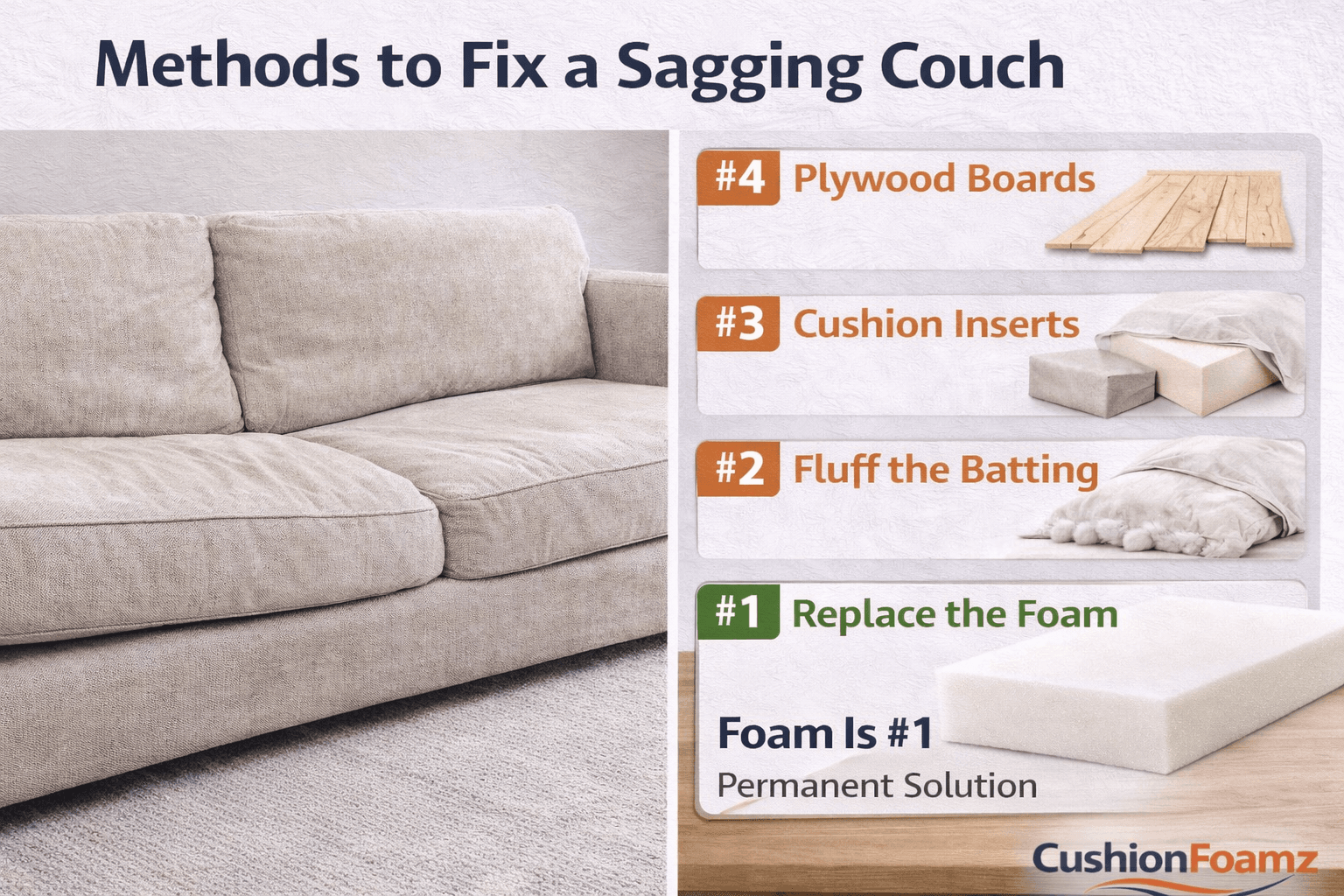
How to Fix a Sagging Couch: Every Method Ranked (Foam Replacement Is #1)
Your couch sags. You sink into a valley every time you sit down. You feel the frame beneath you. Getting up requires a push off the armrest. The cushions do not bounce back anymore — they just stay compressed in the shape of whoever sat there last.
Before you resign yourself to buying a new sofa or suffering through another year of back pain, know this: there are multiple ways to fix a sagging couch, and most of them cost less than a nice dinner out. But they are not all equally effective, and some are temporary band-aids while others are permanent solutions.
This guide ranks every common fix from least effective to most effective, explains how each one works, and helps you choose the right approach for your specific situation. Spoiler: foam replacement is the permanent fix for the vast majority of sagging sofas.
First: Diagnose the Cause of the Sag
Not all sagging has the same root cause, and the right fix depends on what is actually failing. There are three possible culprits:
Cause 1: The Foam Is Compressed (Most Common — 85% of Cases)
The foam inside your cushions has lost its cellular structure through years of repeated compression. It no longer has the physical ability to push back against your weight. This is the cause in the overwhelming majority of sagging sofas.
How to test: Remove a cushion and inspect the foam. Is it thinner than it used to be? Does it fold easily without springing back? Does it hold body impressions? If yes, the foam is the problem.
Cause 2: The Support System Has Failed (10% of Cases)
Beneath the cushions, your sofa has a support system — either sinuous (S-shaped) springs, eight-way hand-tied springs, or webbing straps. If this system has broken or stretched, the entire seating deck sags downward. Even good foam will feel unsupported if the deck beneath it has failed.
How to test: Remove all cushions and press down on the sofa deck (the fabric or platform under the cushions). Does it feel firm and level? Or does it sag, sway, or flex significantly? If the deck itself sags without cushions on it, the support system needs attention.
Cause 3: The Frame Is Damaged (5% of Cases)
Broken frame rails, cracked joints, or failed corner blocks can cause structural sagging that no cushion fix will address. This is rare in quality sofas but possible in budget furniture or very old pieces.
How to test: Flip the sofa on its side or back and inspect the frame. Look for cracked wood, loose joints, or separated components. If you find structural damage, a furniture repair specialist is needed before addressing the cushions.
In most cases, the answer is the foam. Fix the foam and you fix the couch. Now let us rank every method.
The Fixes, Ranked from Worst to Best
Fix #7 (Worst): Plywood Board Under the Cushions
What it is: Placing a sheet of plywood or particleboard on the sofa deck beneath the cushions to create a flat, firm surface.
Cost: $10–$30 for a cut sheet of plywood.
Does it work? Barely. The plywood creates a hard, flat platform that prevents the deck from sagging, but it does nothing to address compressed foam. You end up sitting on flat foam on top of a hard board — which is marginally better than flat foam on a sagging deck, but still uncomfortable. The seating feels rigid and unforgiving because there is no flex in the support system.
Verdict: Emergency fix only. Use this temporarily if your springs have broken AND you cannot replace the foam yet. Never use as a permanent solution.
Fix #6: Cushion Stuffing / Adding Fiberfill
What it is: Opening the cushion covers and stuffing extra polyester fiberfill or batting into and around the existing foam to add volume.
Cost: $20–$50 for batting material.
Does it work? For about two to four weeks. The added fiberfill creates temporary puffiness, but it compresses quickly under seated weight because loose batting has no structural integrity. Within a month, you are back where you started — plus the fiberfill tends to shift and bunch, creating lumpy, uneven cushions that look worse than the original flat ones.
Verdict: Waste of time and money. The batting addresses volume but not support. See our complete couch cushion replacement guide for the fix that actually works.
Fix #5: Cushion Support Inserts (Foam Boards or Plastic Grids)
What it is: Commercial products that slide between the sofa deck and the cushions — typically thin foam boards, plastic grid panels, or interlocking support systems sold specifically as "sagging sofa fixers."
Cost: $25–$60 for a commercial support insert.
Does it work? Slightly better than plywood because these products are designed for the purpose and some have a slight cushioning effect. But they share the fundamental problem: they support from underneath without restoring the cushion foam itself. If your foam is compressed to two inches of mush, a firm board beneath it does not make the foam comfortable again.
Verdict: Marginally effective as a supplement if the sofa deck is sagging AND the foam is still okay. Useless as a standalone fix for compressed foam.
Fix #4: Flipping or Rotating Cushions
What it is: Flipping cushions over (if they are the same fabric on both sides) or rotating their positions so the most-used sections get a break.
Cost: Free.
Does it work? For cushions with uneven wear, flipping can help — the less-compressed side provides better support until it too degrades. Rotating positions distributes wear more evenly going forward. But this only works if the foam still has life in it. Completely compressed foam is compressed on both sides; flipping just gives you the back side of the same dead material.
Verdict: Good preventive maintenance on newer foam. Ineffective fix for foam that has already fully degraded. We recommend regular rotation as a lifespan-extending habit — see our guide on how long cushion foam lasts.
Fix #3: Foam Topper Over Existing Cushions
What it is: Adding a two to three inch foam slab or mattress topper on top of the existing cushions to create a new comfort surface.
Cost: $30–$80 for a pre-cut foam topper.
Does it work? Better than most hacks because you are adding actual foam. But toppers have significant limitations: they raise the seating height (often uncomfortably), they slide around on top of the existing cushions, they do not fit inside cushion covers so they look makeshift, and they still have the collapsed original foam beneath them creating an uneven base.
Verdict: Acceptable temporary fix if you need something right now and cannot wait for custom foam. But the better answer is always replacing the foam inside the covers for a professional result at a similar cost.
Fix #2: Tightening or Replacing the Support System
What it is: If the sofa deck (springs or webbing) has sagged or failed, repairing or replacing it restores the foundation beneath the cushions.
Cost: $50–$200 for DIY spring repair. $150–$500 for professional repair.
Does it work? Yes — for the 10 percent of sagging cases where the support system is the problem. If your springs have stretched or a webbing strap has broken, this fix is necessary and effective. Many online tutorials show how to retie sinuous springs or replace webbing straps.
Verdict: Essential if the deck sags without cushions on it. But if the deck is solid and only the cushions sag, this fix addresses the wrong problem.
Fix #1 (Best): Replace the Foam
What it is: Removing the degraded foam from your cushion covers and replacing it with new, higher-quality custom-cut foam.
Cost: $60–$350 for a complete sofa, depending on size and number of cushions. See our full cost breakdown for detailed pricing.
Does it work? Permanently. New foam restores the structural support, cushion height, rebound, and comfort that degraded foam has lost. If you upgrade from the manufacturer's original foam (typically 1.5–1.8 lb/ft³) to professional-grade 2.8 lb HR foam, the replacement will actually outperform the sofa's original feel — because you are using better material than the factory installed.
Verdict: The definitive fix for 85+ percent of sagging sofas. It is permanent, cost-effective, and produces results that look and feel professional. Combined with the support system repair (Fix #2) if needed, it handles 95+ percent of all sagging couch scenarios.
The Ideal Approach: Foam Replacement + Support Check
For the most thorough fix, combine both:
- Remove cushions and inspect the support deck. Press on it, sit on the bare deck, and check for sagging or broken components. If the deck is solid, skip to step 3.
- Repair the support system if needed. Retighten sinuous springs, replace broken webbing, or add supplemental support straps.
- Measure your cushion covers from seam to seam. Follow our measuring guide for accuracy.
- Order custom-cut 2.8 lb HR foam from our configurator. Choose indoor foam for living room sofas or outdoor foam for patio furniture.
- Install the new foam — the process takes fifteen minutes per cushion.
Total cost for most sofas: $60 to $350 for foam plus $0 to $50 for any support repairs. Total time: one afternoon. The result: a sofa that feels better than new.
When to Replace the Sofa Instead of the Foam
Foam replacement is the right answer for the vast majority of situations, but there are cases where a new sofa makes more sense:
- The frame is broken and repair is not cost-effective (typically only an issue with very budget furniture).
- The fabric is severely damaged — torn, stained beyond cleaning, or worn through. Though even here, reupholstering is often cheaper than a new sofa.
- You want a completely different style or size — foam replacement restores comfort but does not change the sofa's design.
- The sofa was very inexpensive and the foam cost would exceed 30 to 40 percent of the sofa's original price.
For everyone else — which is most people with a decent sofa that just needs better cushions — foam replacement is the clear winner. See our before and after transformations for real-world proof of what new foam does for sagging sofas.
Frequently Asked Questions
My couch sags even with the cushions removed. Is foam replacement still the answer?
No — you need to fix the support system first. The sag is in the deck (springs or webbing), not the cushions. Repair the deck, then replace the foam for a complete fix. Both issues often coexist in older sofas.
Will new foam make my couch feel too firm?
New foam feels firmer than what you are used to because your old foam has been degrading gradually for years. You have adapted to the progressive softening without realizing it. After one to two weeks of use, new medium-firm HR foam breaks in to its optimal comfort level and most people describe it as perfectly supportive — not hard, not soft, but right.
Can I fix a sagging couch without removing the cushion covers?
Not effectively. Every permanent fix requires either accessing the foam inside the covers or accessing the support system beneath the cushions. Both require removing the cushions. The good news: if your covers have zippers, the entire process is tool-free and takes minutes per cushion.
How do I prevent my new foam from sagging again?
Three habits extend foam life dramatically: rotate and flip cushions monthly, avoid storing heavy items on cushions when not in use, and start with high-density foam (2.8 lb/ft³ HR foam lasts eight to fifteen years vs. one to three years for budget foam). For more tips, see our foam care and storage guide.
The Bottom Line
A sagging couch is a foam problem, and foam problems have a foam solution. The internet is full of hacks — plywood boards, cushion inserts, batting stuffing — but none of them address the actual cause. New, high-quality foam does.
For $60 to $350, you restore your sofa to better-than-original comfort in a single afternoon. Compare that to $1,000 to $5,000+ for a new sofa (that comes with the same cheap foam that will sag again in three to five years) and the decision is obvious.
Ready to fix your sagging couch for good? Build your custom foam order →
Start with our complete replacement guide for the step-by-step process, or check out our How It Works page to see how ordering works from start to finish.