Restaurant Booth and Bar Stool Cushion Foam Replacement Guide
Your restaurant's seating makes a first impression before the menu does. When a guest slides into a booth and the cushion compresses to nothing, or perches on a bar stool with a seat that feels like plywood with a vinyl cover, the dining experience starts at a deficit no amount of excellent food fully recovers.
Commercial seating foam degrades faster than residential foam because the usage volume is dramatically higher. A restaurant booth might seat thirty to fifty people per day — the equivalent of a decade of residential use compressed into a single month. When that foam goes flat, replacing it with the right material is one of the fastest, most cost-effective improvements a restaurant owner or manager can make.
This guide covers foam selection for commercial seating, how to measure booths and bar stools, durability expectations under restaurant traffic, and how to plan a refoaming project that minimizes downtime.
Why Commercial Seating Foam Fails Faster
The math is straightforward. A residential sofa cushion might see two to four hours of use per day from one to four people. A restaurant booth seat sees eight to fourteen hours of use per day from dozens of different people across multiple seatings. The compression cycles accumulate five to ten times faster than residential use.
Most restaurant seating ships with standard 1.5 to 1.8 lb/ft³ commercial-grade foam — adequate for the first six to twelve months, then progressively failing as the cell structure collapses under relentless daily traffic. By year two, the booths that once felt welcoming now feel like hard benches with a thin layer of nothing on top.
The solution is the same as residential replacement but with even greater emphasis on density: 2.8 lb/ft³ high-resiliency foam handles commercial traffic volumes for five to ten years — dramatically longer than standard commercial foam. The upfront cost is marginally higher, but the replacement frequency drops from every one to two years to every five to ten years. The math heavily favors quality foam in commercial settings.
Foam Selection for Restaurant Seating
Indoor Booth and Banquette Seating
For all enclosed indoor restaurant seating — booths, banquettes, dining chairs, waiting area benches — our 2.8 lb HR indoor foam in medium-firm is the right choice.
Medium-firm firmness is particularly important in restaurants. Softer foam allows guests to sink in, which feels comfortable initially but makes it harder to sit upright for dining and more difficult to slide in and out of booths. Medium-firm provides enough cushioning to be comfortable while maintaining the posture support that dining requires.
Thickness recommendations:
| Seating Type | Recommended Thickness |
|---|---|
| Booth seat cushion | 3–4 inches |
| Booth back cushion | 2–3 inches |
| Banquette seat | 3–4 inches |
| Dining chair seat pad | 1.5–2 inches |
| Bar stool seat | 2–3 inches |
| Waiting area bench | 3–4 inches |
Outdoor and Patio Dining Seating
For restaurant patio seating, rooftop bars, sidewalk café chairs, and any outdoor dining surface, Dry Fast outdoor foam is mandatory. Standard foam in an outdoor dining environment will absorb spills, rain, and morning dew, creating hygiene issues that no restaurant can afford.
Dry Fast foam drains liquids instantly and resists mold — critical properties for outdoor dining where cushions encounter spilled drinks, food residue, and weather. For the full comparison, see our indoor vs. outdoor foam guide.
Bar Stool Considerations
Bar stool seats present a unique challenge: small surface area, high compression from seated weight concentrated on a small foam footprint, and frequent rotation and friction from guests pivoting on the seat.
For bar stools, use firm foam at 2 to 3 inches thick. Firm foam on a small seat prevents the bottoming-out that soft foam experiences when body weight is concentrated on a 14 to 16 inch diameter circle. The higher firmness also resists the rotational shear forces that bar seating creates.
Round bar stool seats can be ordered through our configurator by selecting the circle shape and entering the diameter.
Measuring Restaurant Seating
Booth Seats
Most restaurant booths have a single long seat cushion per side, or two to three sections that sit side by side:
- Length: Measure the full bench length from one side panel to the other.
- Depth: Measure from the front edge of the seat to the backrest (the sitting depth).
- Thickness: Measure the existing cushion from top seam to bottom seam, or choose your desired thickness if building new.
For the complete measuring methodology, reference our cushion measuring guide. The same principles apply — measure covers or platforms from seam to seam, add half an inch for snug fit.
Booth Backs
Booth back cushions are measured the same way:
- Width: Matches the booth length (or slightly shorter if there are side returns).
- Height: Measure the padded area from the seat surface to the top of the back padding.
- Thickness: Typically 2 to 3 inches. Thinner than seat cushions since back cushions bear less weight.
Bar Stools
For round bar stool seats:
- Diameter: Measure across the widest point of the seat surface.
- Thickness: Measure the existing cushion, or choose 2 to 3 inches for new builds.
For square or rectangular bar stool seats, measure width and depth.
Dining Chairs
For individual restaurant chairs:
- Width and depth of the seat surface.
- Thickness: 1.5 to 2 inches for seat pads on hard chairs.
- For contoured or irregular seats, make a paper template.
Planning a Restaurant Refoaming Project
Phased vs. Complete Replacement
Complete replacement (recommended): Replace all seating foam in a single project during a planned closure day (many restaurants close Mondays or have slow midweek periods). Benefits: uniform comfort across all seating, efficient ordering and installation, and one disruption instead of multiple.
Phased replacement: Replace the most-worn booths first (typically the most popular and busiest sections), then address remaining sections over subsequent weeks or months. Benefits: spreads the cost over time. Drawback: guests notice inconsistency between fresh and worn sections.
Minimizing Downtime
Foam replacement is fast. A skilled team of two to three people can re-foam an entire restaurant's booth seating in four to eight hours. The process for each booth:
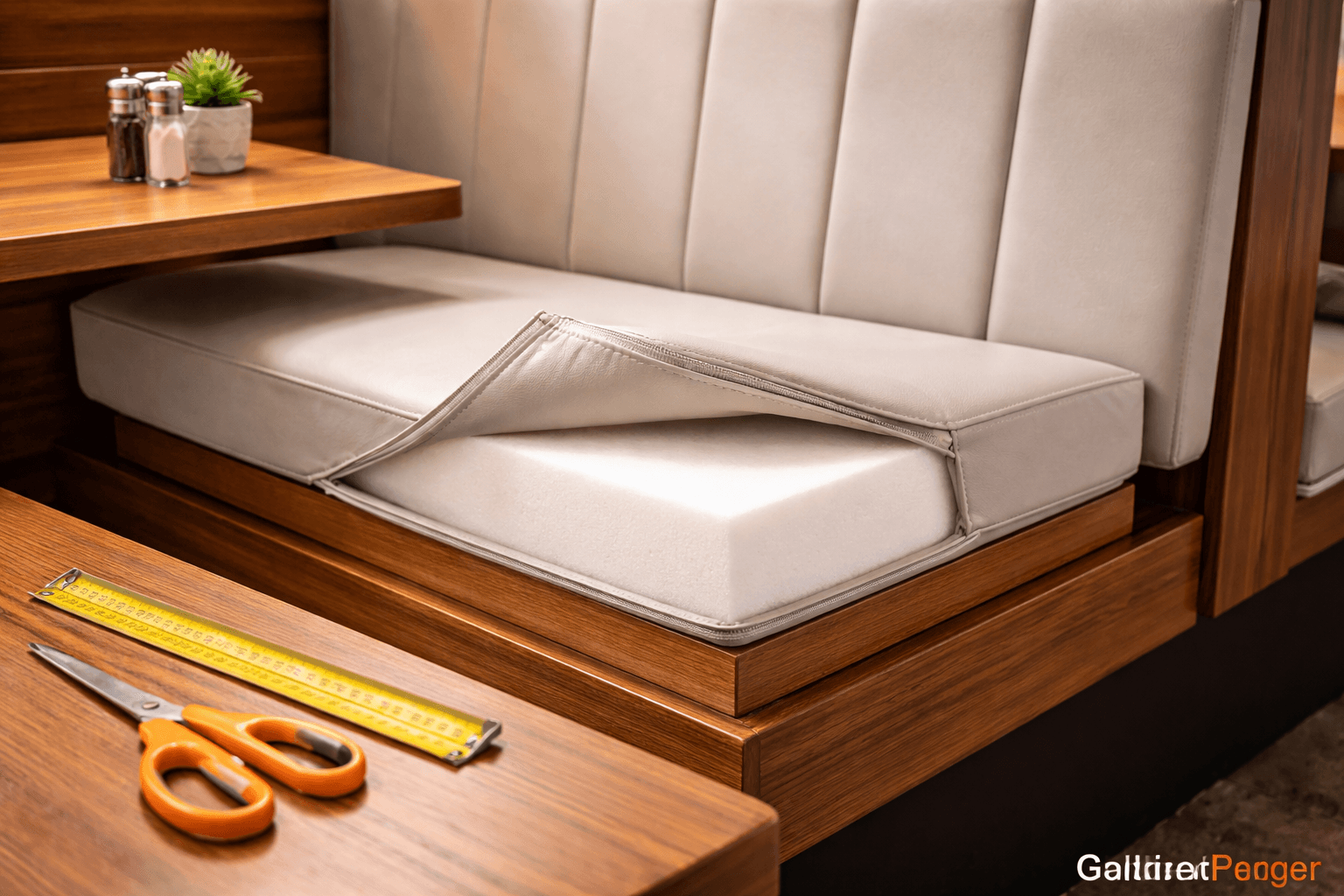
- Remove the existing cushion (or cushion cover if the foam is inside a cover).
- Extract old foam.
- Insert new pre-cut foam (already ordered to exact dimensions).
- Reassemble.
Time per booth: 15 to 30 minutes including back cushions.
Scheduling recommendation: Order foam two weeks before your planned installation date. Have all foam on-site and organized by booth location before the work begins. Start after dinner service closes and have everything done before the next day's opening.
Cost Estimation
| Project Scope | Typical Foam Cost |
|---|---|
| Single booth (seat + back, one side) | $40–$80 |
| Double booth (seat + back, both sides) | $80–$160 |
| 10-booth restaurant (both sides) | $800–$1,600 |
| 20 bar stools | $200–$400 |
| Complete 15-booth + 10-stool restaurant | $1,400–$2,800 |
These are foam-only costs using our 2.8 lb indoor HR foam at $0.07 per cubic inch. Cover replacement, if needed, is additional. Many restaurants have reupholstery professionals who handle the cover work — your foam order gives them the exact dimensions to plan around.
Free shipping on orders over $199, which all restaurant projects exceed.
Durability Expectations
| Foam Type | Expected Lifespan in Restaurant Setting |
|---|---|
| Budget foam (1.5 lb) | 6 months – 1.5 years |
| Standard commercial (1.8 lb) | 1–3 years |
| Quality HD (2.0–2.2 lb) | 3–5 years |
| HR foam (2.8 lb) — our product | 5–10 years |
The five to ten year range for HR foam in restaurant use is not theoretical — it is what professional restaurant upholsterers report from field experience. The cold-cure cell structure of HR foam resists the repeated high-volume compression cycles of commercial seating far better than conventional polyurethane. For the technical reasons why, see our HR vs. HD foam comparison.
Hygiene and Maintenance
Foam Hygiene
Our foam is CertiPUR-US certified, meeting safety and emissions standards. For restaurant applications where food contact is proximate, this certification provides documented assurance of material safety.
For spills that reach the foam through cover fabric: indoor HR foam can be spot-cleaned with mild soap and water and air-dried. It should not be soaked — while indoor foam is not water-damaged by occasional spills, it should not be saturated. For outdoor restaurant seating, Dry Fast foam handles full washdowns without issue.
Cover Maintenance
Restaurant cushion covers should be cleaned weekly in high-traffic areas. Vinyl covers can be wiped down with sanitizing solution after each service. Fabric covers should be vacuumed weekly and deep-cleaned monthly. Removable zippered covers make cleaning significantly easier than fixed upholstery.
Related Commercial Applications
The same foam and ordering process applies to other commercial seating needs:
- Hotel lobby and room seating — High-traffic lounges and guest room furniture
- Café and coffee shop seating — Benches, armchairs, window seats
- Office reception areas — Waiting room seating that sees dozens of visitors daily
- Country club and resort seating — Indoor and outdoor lounge areas
- Hair salon and spa seating — Waiting areas and styling chairs
For houses of worship with similar high-volume seating needs, see our church pew cushion guide.
How to Order
- Measure all seating — Create a spreadsheet listing each piece of seating with its dimensions.
- Enter each unique size into our configurator — Select indoor HR foam for enclosed dining areas, outdoor Dry Fast for patios.
- Review your total — Our transparent pricing shows you the exact cost with no hidden fees.
- Place your order — Most orders ship within 2 to 5 business days. Free shipping over $199.
For large commercial projects, contact us directly to discuss scheduling, phasing, and any custom requirements.
The Bottom Line
Restaurant seating is a direct reflection of how much you care about your guests' experience. Flat, uncomfortable booths and bar stools communicate neglect — even if every other aspect of your restaurant is exceptional. For $1,000 to $3,000 in foam (less than one busy Friday night's revenue for most restaurants), you can refoam your entire dining room with professional-grade material that lasts five to ten years.
The return on investment is immediate: more comfortable guests stay longer, order more, and come back more often. That is a renovation that pays for itself in weeks, not years.
Ready to upgrade your restaurant seating? Build your commercial foam order →
Explore our upholstery foam options for full product specifications, or contact us for large-project coordination.